
Agonopterix senicionella
(Busck, 1902)
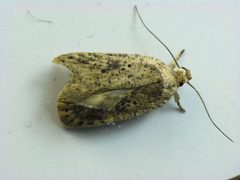
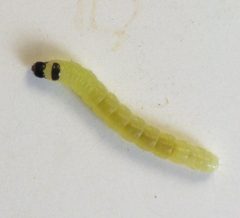
Agonopterix senicionella is a small in the Depressariidae, described by August Busck in 1902. It is restricted to the eastern United States, with records from Kentucky, Michigan, Ohio, Virginia, and West Virginia. The is a herbivore whose larvae feed exclusively on Packera aurea, a plant formerly classified as Senecio aureus. are recognized by their distinctive wing pattern of dark ochrous gray with brownish suffusion and characteristic black discal dots.
Pronunciation
How to pronounce Agonopterix senicionella: /ˌæɡoʊˈnɒptərɪks sɛˌnɪʃiˈoʊnɛlə/
These audio files are automatically generated. While they are not always 100% accurate, they are a good starting point.
Identification
The combination of small size (18–22 mm wingspan), dark ochrous gray forewings with brownish suffusion, and the specific pattern of black discal dots (two at basal third, one at end of ) distinguishes this from other Agonopterix. The light basal patch with blackish-fuscous spot in the fold and the fuscous-suffused are additional diagnostic features. Similar species in the lack this precise arrangement of markings and basal patch structure.
Images
Appearance
Wingspan 18–22 mm. Forewings dark ochrous gray, overlaid and suffused with brownish ochrous. Light basal patch present, suffused with fuscous on , containing a blackish-fuscous spot in the fold and bordered outwardly by a fading fuscous shade. Two black discal dots at basal third in , plus a black discal dot at end of cell preceded by an indistinct fuscous shade. Termen and costa marked with ill-defined fuscous spots. Hindwings grayish fuscous, darker apically.
Habitat
Associated with supporting its larval plant Packera aurea, which occurs in moist woodlands, stream banks, and wet meadows in eastern North America. Specific microhabitat preferences are not documented.
Distribution
Eastern United States: recorded from Kentucky, Michigan, Ohio, Virginia, and West Virginia. The distribution appears to track that of its larval plant.
Seasonality
period not explicitly documented in available sources; likely corresponds with plant growing season.
Diet
Larvae feed on Packera aurea (formerly Senecio aureus). feeding habits unknown.
Host Associations
- Packera aurea - larval Formerly classified as Senecio aureus; specific to this plant
Ecological Role
herbivore; likely tied to availability of Packera aurea. Potential role as prey for not documented.
Human Relevance
No documented economic or cultural significance. Of potential interest to lepidopterists studying -plant specialization.
Similar Taxa
- Other Agonopterix speciesShare general wing pattern elements but differ in specific arrangement of discal dots, basal patch structure, and coloration; many feed on different plants in Asteraceae or Apiaceae
More Details
Nomenclature
The specific epithet 'senicionella' references the former plant name Senecio aureus, reflecting the ' close association with this plant. The plant has since been reclassified to Packera aurea.
Taxonomic history
Described by August Busck in 1902, a prominent American lepidopterist who described numerous North American microlepidoptera.