
Agonopterix pteleae
Barnes & Busck, 1920
A small in the Depressariidae, described from North America in 1920. have distinctive mottled brown forewings with prominent dark markings. Larvae are known to feed on Ptelea trifoliata (common hoptree). The has a restricted distribution centered on the Great Lakes region.
Pronunciation
How to pronounce Agonopterix pteleae: /ˌæɡəˈnɒptərɪks ˈptɛliˌi/
These audio files are automatically generated. While they are not always 100% accurate, they are a good starting point.
Identification
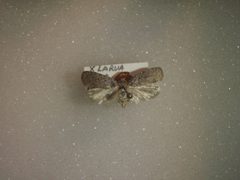
The combination of small size (20–22 mm wingspan), light ocherous brown forewings with heavy blackish mottling, and the distinctive large costal blotch extending to the distinguishes this from most other Agonopterix . The whitish ocherous base at the inner angle, broadly edged with black, provides an additional diagnostic feature. Similar species in the lack the prominent costal blotch pattern.
Images
Habitat
Associated with plant Ptelea trifoliata, which grows in open woodlands, forest edges, and rocky slopes. likely found in where common hoptree occurs.
Distribution
Recorded from Illinois, Michigan, and Ohio in the north-central United States. Distribution appears restricted to the Great Lakes region.
Diet
Larvae feed on Ptelea trifoliata (common hoptree, Rutaceae). feeding habits unknown.
Host Associations
- Ptelea trifoliata - larval
Ecological Role
Herbivore; larval feeding on Ptelea trifoliata. Specific ecological impacts unknown.
Human Relevance
No documented economic or medical significance. Of potential interest to lepidopterists studying Depressariidae diversity.
Similar Taxa
- Other Agonopterix speciesMany share similar size and general wing pattern, but A. pteleae is distinguished by the large blackish-fuscous costal blotch extending to the end of the and the whitish ocherous base at the inner angle.
More Details
Nomenclature
Authorship sometimes cited as 'Barnes, 1920' or 'Barnes & Busck, 1920'; both forms appear in literature. The epithet 'pteleae' refers to the Ptelea.
Taxonomic history
Described by William Barnes and August Busck in 1920, based on specimens from the north-central United States. Remains in the Agonopterix; no recorded transfers or synonymy.