
Eteobalea sexnotella
(Chambers, 1878)
Eteobalea sexnotella is a small in the Cosmopterigidae, native to North America. are active from January and March through September, with a wingspan of approximately 17 mm. The is notable for its larval association with two Trichostema plant species, where larvae develop within stem galls.
Pronunciation
How to pronounce Eteobalea sexnotella: /ˌɛ.ti.oʊˈbæ.li.ə sɛks.nɔːˈtɛl.lə/
These audio files are automatically generated. While they are not always 100% accurate, they are a good starting point.
Identification
The wingspan of about 17 mm provides a general size reference, though specific diagnostic features distinguishing this from are not documented in available sources.
Images
Appearance
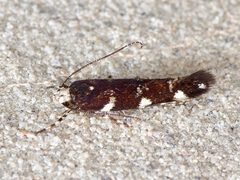
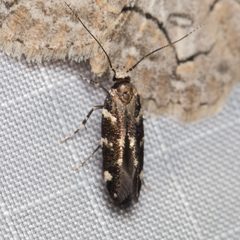
A small with a wingspan of approximately 17 mm. Specific coloration and pattern details are not documented in available sources.
Habitat
Associated with plants Trichostema dichotomum and Trichostema suffrutescens, which occur in various open in eastern North America. The larval stage develops within stem galls on these plants.
Distribution
Recorded from New Hampshire south to Florida, west to Arkansas and Texas, and north to Ontario, Canada.
Seasonality
active in January and from March through September. Larval activity within stem galls presumably overlaps with or precedes adult periods, though specific timing is not documented.
Diet
Larvae feed on Trichostema dichotomum and Trichostema suffrutescens, developing within stem galls. feeding habits are not documented.
Host Associations
- Trichostema dichotomum - larval plantlarvae develop in stem galls
- Trichostema suffrutescens - larval plantlarvae develop in stem galls
Life Cycle
Larvae develop within stem galls on plants. Details of , pupal, and longevity are not documented.
Behavior
Larvae induce and inhabit stem galls on plants. activity spans multiple months with a notable January record.
Ecological Role
As a gall-forming herbivore, larvae modify plant stem tissue, potentially affecting plant growth and providing microhabitat for associated organisms.
Similar Taxa
- Eteobalea intermediellaAnother North American Eteobalea ; specific distinguishing characters require examination of genitalia or detailed wing pattern analysis not available in general sources.
- Other CosmopterigidaeSmall size and general overlap with many cosmopterigid ; accurate identification requires examination.
More Details
Gall formation
The stem gall association with Trichostema is a distinctive biological feature of this species, though the specific mechanism of gall induction has not been described.
Taxonomic history
Originally described by Chambers in 1878.