
Walshia
Clemens, 1864
Species Guides
6- Walshia amorphella
- Walshia dispar
- Walshia elegans
- Walshia exemplata
- Walshia floridensis
- Walshia miscecolorella(Sweet Clover Root Borer Moth)
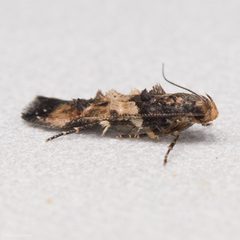
Walshia is a of small in the Cosmopterigidae, established by Clemens in 1864. The genus contains at least 12 described distributed in North America. At least one species, W. amorphella, is known to induce galls on its plant, creating complex ecological microcommunities. Most species remain poorly studied beyond basic taxonomic descriptions.
Pronunciation
How to pronounce Walshia: /ˈwɔːlʃiə/
These audio files are automatically generated. While they are not always 100% accurate, they are a good starting point.
Identification
Members of Walshia can be distinguished from other Cosmopterigidae by genitalia characteristics and wing pattern details, though specific diagnostic features require examination. The genus is small-bodied with narrow wings typical of the . -level identification relies on dissection and comparison with .
Images
Habitat
Associated with plants; W. amorphella occurs on Amorpha fruticosa in riparian and open woodland . Other ' habitat associations are largely undocumented.
Distribution
North America; specific ranges vary by . W. amorphella has been documented where its plant Amorpha fruticosa occurs.
Host Associations
- Amorpha fruticosa - plantW. amorphella induces galls on this plant
Behavior
W. amorphella induces galls on plants, creating that supports an associated microcommunity of other organisms. Gall induction represents the primary documented behavioral trait for the .
Ecological Role
W. amorphella functions as a gall-former, creating novel microhabitats that support additional in a microcommunity structure. The ecological roles of other Walshia species are unknown.
Similar Taxa
- Other Cosmopterigidae generaSimilar small size and wing shape; distinguished by genitalia and specific wing pattern elements
More Details
Species diversity
Twelve are currently recognized: W. albicornella, W. amorphella, W. calcarata, W. detracta, W. dispar, W. elegans, W. exemplata, W. floridensis, W. miscecolorella, W. particornella, W. pentapyrga, and W. similis. Most were described by Hodges in 1961 and 1978.
Research status
W. amorphella is the most studied due to its gall-forming . Other species remain known primarily from and basic descriptions.