
Coleophora serratella
(Linnaeus, 1761)
Cigar Casebearer Moth, Birch-Alder Casebearer
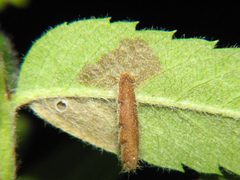
A small case-bearing with a wingspan of 11–14 mm. are active in June and are difficult to identify without dissection and microscopic examination of genitalia. Larvae feed on birch, alder, and other woody plants, constructing portable cases from silk and plant material. The occurs across Europe (except the Balkan Peninsula), Japan (Hokkaido), and North America.
Pronunciation
How to pronounce Coleophora serratella: /kəʊliːˈɒfərə sɛˈreɪtəllə/
These audio files are automatically generated. While they are not always 100% accurate, they are a good starting point.
Identification
are distinguished from other Coleophora primarily by genitalia ; external features overlap broadly with . The combination of dark fuscous, ochreous-tinged forewings and dark fuscous hindwings provides tentative external guidance. Larval cases may offer additional identification cues when plant and case construction details are considered.
Images
Habitat
Associated with birch, alder, and mixed deciduous woodlands. Found in windbreaks, floodplain forests, and areas with varying diversity. Larval development occurs on plant foliage.
Distribution
Europe (except Balkan Peninsula), Japan (Hokkaido), and North America. Documented from Belgium with regional presence in Brussels-Capital, Flemish, and Walloon regions.
Seasonality
period in June, varying with location.
Diet
Larvae feed on leaves of birch (Betula), alder (Alnus), elm (Ulmus), hazel (Corylus), apple (Malus), hawthorn (Crataegus), rowan (Sorbus), willow (Salix), sweetfern (Comptonia peregrina), and interior live oak (Quercus wislizenii).
Host Associations
- Betula - larval food plantPrimary ; 'birch-alder casebearer' reflects association
- Alnus - larval food plantPrimary
- Ulmus - larval food plant
- Corylus - larval food plant
- Malus - larval food plant
- Crataegus - larval food plant
- Sorbus - larval food plant
- Salix - larval food plant
- Comptonia peregrina - larval food plant
- Quercus wislizenii - larval food plant
Life Cycle
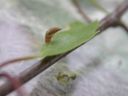
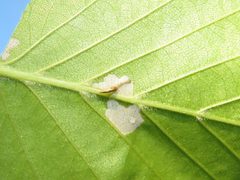
Complete . Larvae are case-bearers, constructing portable cases from silk and plant material in which they live and feed. Larval development period extended by 3 days when feeding on damaged foliage compared to undamaged foliage. occurs within the larval case. in June.
Behavior
Larvae construct and inhabit portable cases made of silk and plant material, carrying them while feeding. When foliage is mechanically damaged, larvae move away from damaged areas within 24 hours; after 8 days, larvae on previously damaged leaves produce significantly smaller mines than those on undamaged leaves. Larval damage patterns on birch are aggregated rather than hyperdispersed despite induced movement.
Ecological Role
Herbivore on deciduous trees and shrubs. Subject to by at least 25 of larval and pupal , including Apanteles spp. and other . and parasitism rates vary with diversity— are more stable (lower amplitude fluctuations) in species-rich floodplain forests compared to uniform windbreak habitats.
Human Relevance
Minor forestry concern as a defoliator of birch and alder. fluctuations studied in context of and management. Attempted introduction of Orgilus punctulator for control proved unsuccessful in Swiss Rhone Valley.
Similar Taxa
- Other Coleophora speciesExternal highly similar; reliable separation requires genitalia dissection and microscopic examination. Many share narrow wings, long-fringed hindwings, and case-bearing larval habits.
Sources and further reading
- BugGuide
- Wikipedia
- GBIF taxonomy match
- iNaturalist taxon
- NCBI Taxonomy
- Catalogue of Life
- The biology of Coleophora serratella (L.) (Lepidoptera: Coleophoridae)
- Populationsfluktuationen und Parasitierung der Birken‐Erlenminiermotte (Coleophora serratella L.) in Abhängigkeit von der Habitat‐Diversität
- The effects of foliage damage on casebearing moth larvae, Coleophora serratella , feeding on birch