
Coleophora deauratella
Zeller, 1846
Red clover casebearer moth
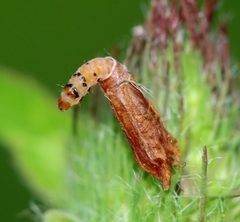
Coleophora deauratella is a small case-bearing (wingspan 11–13 mm) in the Coleophoridae. Native to Europe, Asia Minor, and Tasmania, it has become an pest in North America and New Zealand where it causes severe damage to red clover seed production. Larvae feed on developing seeds within red clover florets, with reported yield losses up to 90% in affected regions. are active in summer, with peak typically occurring in June–July in the native range and December in New Zealand.
Pronunciation
How to pronounce Coleophora deauratella: /kəˌliːəˈfɔːrə diːəˌrɑːtəˈlɑː/
These audio files are automatically generated. While they are not always 100% accurate, they are a good starting point.
Identification
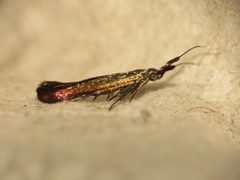
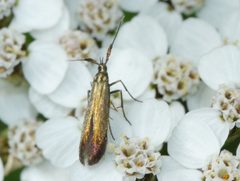
Distinguished from similar Coleophora by combination of metallic bronze , brassy bronze forewings with coppery apex, and dark grey hindwings. Separated from C. frischella (with which it was historically confused) based on genitalic characters; the two species were not distinguished until 1976. Antennal scaling pattern and wing coloration provide field identification cues.
Images
Appearance
Small with wingspan 11–13 mm. metallic bronze. dark grey with white apex, thickened at base with dense dark coppery-bronzy extending beyond the first three segments. Forewings shining brassy bronze with coppery tinge toward apex. Hindwings dark grey.
Habitat
Grassy in native range; red clover seed crops and hay fields in agricultural areas. In invaded regions, strongly associated with commercial red clover seed production systems.
Distribution
Native: most of Europe, Asia Minor, Lebanon, Tasmania. : North America (first detected Alberta, Canada 2006; western Oregon, USA 2011), New Zealand (first confirmed 2016, now widespread from Invercargill to Masterton). Common in parts of Southern England.
Seasonality
on wing June–July in native European range. In New Zealand, adult correlated with thermal time (285°C days from 1 July, baseline 12°C), with peak in December and monitoring period November–February.
Diet
Larvae feed on developing seeds of red clover (Trifolium pratense) within individual florets.
Host Associations
- Trifolium pratense - Red clover; larvae feed on developing seeds within florets
Life Cycle
Larval stage feeds within red clover florets on developing seeds. temperature-dependent; in New Zealand, half of adult emergence occurs at 285°C days from 1 July with baseline temperature of 12°C.
Behavior
Larvae feed inside individual red clover florets, consuming developing seeds. Male used for communication and monitoring. In invaded regions, synthetic have been deployed for .
Ecological Role
In native range, causes only minor damage. In invaded regions, significant agricultural pest of red clover seed production with potential for severe economic impact; in Oregon and New Zealand showed decline after 2018, with unknown biocontrol agents or other factors speculated.
Human Relevance
Major pest of red clover seed crops in North America and New Zealand, with reported seed yield losses up to 90%. Management includes chemical control (tau-fluvalinate, lambda cyhalothrin, chlorpyrifos provide >90% control), synthetic , and using . In Alberta, crop stand age reduced to 1 year to mitigate losses.
Similar Taxa
- Coleophora frischellaHistorically confused with C. deauratella until separated in 1976; distinguished by genitalic characters
More Details
Taxonomic history
Separated from C. frischella in 1976; earlier records may conflate the two , creating uncertainty in precise native range details.
Genomic resources
assembly available from female specimen collected Oxfordshire, UK, 2022-06-07.
Sources and further reading
- BugGuide
- Wikipedia
- GBIF taxonomy match
- iNaturalist taxon
- NCBI Taxonomy
- Catalogue of Life
- Red clover casebearer moth (Coleophora deauratella) is widespread throughout New Zealand
- Biology and management of Coleophora deauratella (Lepidoptera: Coleophoridae) in red clover seed-growing regions in North America and New Zealand
- The genome sequence of the Red-clover Case-bearer, Coleophora deauratella Zeller, 1846.