
Oegoconia novimundi
(Busck, 1915)
Four-spotted Yellowneck Moth
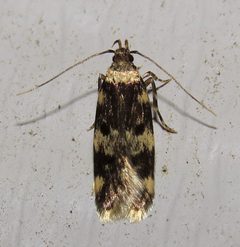
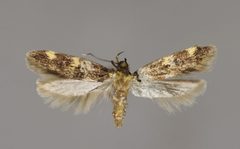
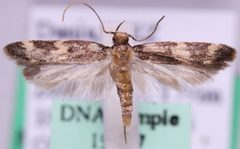
Oegoconia novimundi is a small in the Autostichidae, described by Busck in 1915. It is known from southern and central Europe, including Mediterranean islands, with records spanning from the Iberian Peninsula to the Balkans. The "Four-spotted Yellowneck Moth" refers to diagnostic markings on the . The has been documented across diverse European but detailed remains poorly known.
Pronunciation
How to pronounce Oegoconia novimundi: /ˌiːɡoʊˈkoʊniə ˌnoʊviˈmʌndi/
These audio files are automatically generated. While they are not always 100% accurate, they are a good starting point.
Identification
The "Four-spotted Yellowneck " suggests the presence of four spots and yellowish coloration on the or , though specific diagnostic features are not documented in available sources. The can be distinguished from congeneric Oegoconia species by genitalia examination; molecular or detailed morphological comparisons with O. quadripuncta (a potential senior synonym per GBIF) may be required for definitive identification.
Images
Distribution
Documented from Spain, France, Germany, Austria, Slovakia, Belgium, Croatia, former Serbia and Montenegro, Italy, Bulgaria, Hungary, North Macedonia, Greece, and the islands of Corsica and the Azores. GBIF records confirm presence in Belgium with regional distribution across Flemish and Walloon regions.
Similar Taxa
- Oegoconia quadripunctaGBIF lists O. novimundi as a synonym of O. quadripuncta, indicating potential taxonomic confusion or synonymy that requires verification
- Other Oegoconia speciesCongeneric share similar small size and general , necessitating genitalia dissection or molecular analysis for reliable separation
More Details
Taxonomic Uncertainty
placement has been inconsistent: Wikipedia sources cite both Autostichidae and Symmocidae, though modern sources (Catalogue of Life, NCBI, GBIF) consistently place it in Autostichidae. The GBIF synonymy with O. quadripuncta suggests this may require taxonomic revision.
Observation Frequency
iNaturalist records 3,384 observations, indicating the is encountered with moderate frequency by observers, though this may reflect detection in well-surveyed European regions rather than true abundance.