
Oegoconia
Stainton, 1854
Species Guides
2- Oegoconia deauratella(Scarce Obscure Moth)
- Oegoconia novimundi(Four-spotted Yellowneck Moth)
Oegoconia is a of small in the Autostichidae, Oegoconiinae. are characterized by their small size and relatively plain wing patterns, often with subtle spotting. The genus includes the Four-dotted Obscure (O. quadripuncta), one of three native Autostichidae species in Britain and the subject of sequencing research. Members are primarily and frequently captured in light traps.
Pronunciation
How to pronounce Oegoconia: /ˌiːɡoʊˈkoʊniə/
These audio files are automatically generated. While they are not always 100% accurate, they are a good starting point.
Identification
External alone is insufficient for reliable identification within the ; genitalia examination is required to distinguish closely related species such as O. quadripuncta, O. deauratella, and O. caradjai. In Britain, O. quadripuncta is the most frequently recorded species.
Images
Appearance
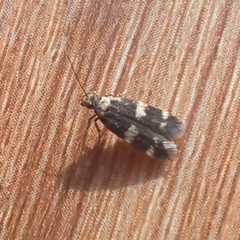
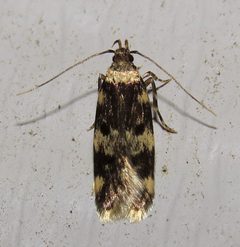
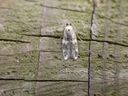
Small with wings held flat at rest. Forewings typically brownish or ochreous with variable spotting patterns; O. quadripuncta has four distinct dots. Externally similar to , with subtle differences in wing pattern and coloration. Reliable identification requires examination of genitalia.
Habitat
Litter layer below trees and hedgerows; gardens. Larval development occurs in decaying leaf litter.
Distribution
Europe: throughout much of England and Wales, locally in Ireland, absent from Scotland; recorded in Belgium (where O. caradjai is more common than O. quadripuncta), Denmark, Norway, Sweden. North America: Vermont, United States.
Seasonality
active in summer; frequently recorded in light traps during this period.
Diet
Larvae feed on decaying leaves in the litter layer.
Life Cycle
Larvae develop in the litter layer, feeding on decaying leaves. emerge in summer and are attracted to light traps.
Behavior
are and frequent visitors to light traps. Specimens characteristically hold their forewings very flat when at rest.
Ecological Role
Larvae contribute to decomposition processes in forest and garden litter layers through consumption of decaying plant material.
Human Relevance
Subject of genomic research; O. quadripuncta sequenced as part of biodiversity initiatives. No known economic significance.
Similar Taxa
- O. deauratellaExternally very similar to O. quadripuncta; distinguished reliably only by genitalia examination
- O. caradjaiExternally very similar to O. quadripuncta; distinguished reliably only by genitalia examination; more common than O. quadripuncta in Belgium
More Details
Genomic resources
of O. quadripuncta sequenced: assembly size 622.6 Mb with 20 chromosomal pseudomolecules (19 + Z ). Specimen from Tonbridge, Kent, UK.