
Glyphidocera lactiflosella
(Chambers, 1878)
five-spotted glyphidocera moth
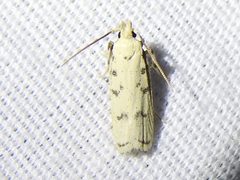
Glyphidocera lactiflosella, commonly known as the five-spotted glyphidocera , is a small moth in the Autostichidae. It was first described by Vactor Tousey Chambers in 1878. The is characterized by its distinctive wing pattern of five brown spots on a pale cream background. It occurs across the southeastern and eastern United States with a notably extended period.
Identification
Distinguished from similar Glyphidocera by the specific arrangement of five brown spots on pale cream forewings, particularly the two middle spots that may be confluent. The curved brown line at the base of the cilia provides an additional diagnostic feature. The silvery-tinged white hindwings contrast with the marked forewings.
Images
Appearance
Small with wingspan approximately 12.7 mm. Forewings pale cream color, sparsely dusted with brown. Five brown spots arranged as follows: one small spot touching the fold near the wing base, one slightly further back, two spots near the middle (one on the fold, one on the disc, sometimes confluent), and a transverse brown streak at the end of the . Distinct brown line curves around the base of the cilia. Hindwings white, tinged with silvery.
Distribution
Southeastern and eastern North America. Recorded from Alabama, Arkansas, Florida, Georgia, Louisiana, Maine, Mississippi, North Carolina, South Carolina, Tennessee, and Texas.
Seasonality
active from January through October, indicating a prolonged period spanning most of the year.
Similar Taxa
- Other Glyphidocera speciesSimilar small size and general , but distinguished by the specific five-spot pattern and curved cilia line described for G. lactiflosella
More Details
Taxonomic history
Originally described as Gelechia lactiflosella by Chambers in 1878, later transferred to Glyphidocera. The epithet 'lactiflosella' derives from Latin roots suggesting milk-flower, possibly alluding to the pale cream wing coloration.
Observation frequency
Well-documented with over 1,300 observations on iNaturalist, indicating it is relatively frequently encountered and photographed by naturalists within its range.