
Eriocraniella platyptera
Davis, 1978
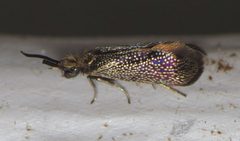
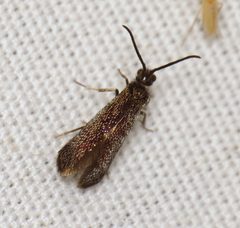
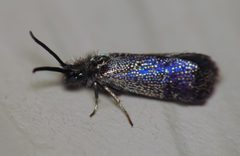
Eriocraniella platyptera is a small primitive in the Eriocraniidae. are active in May with a single . Larvae are leaf miners that feed on oak , particularly Quercus ilicifolia. The species was described by Donald R. Davis in 1978 and is known from the northeastern and southern United States.
Pronunciation
How to pronounce Eriocraniella platyptera: //ˌɛrioʊkrəˈnɪə plæˈtɪptərə//
These audio files are automatically generated. While they are not always 100% accurate, they are a good starting point.
Identification
Distinguished from other Eriocraniidae by the combination of broad forewings, dark fuscous coloration with strong golden brassy to blue-green iridescence, and the contrast with much paler hindwings. The moderately broad are a helpful diagnostic feature. Geographic range from northwestern New York to Texas may overlap with ; precise identification may require examination of genitalia or molecular data.
Images
Appearance
Small with broad forewings measuring 7.8–8.2 mm in males and approximately 8.2 mm in females. Forewings are dark fuscous with a prominent golden brassy to blue-green iridescence. Hindwings are much paler, grayish fuscous with a slight purplish luster. are moderately broad.
Habitat
Associated with oak ; larvae occur in leaves of oak including Quercus ilicifolia. Specific habitat preferences are not well documented.
Distribution
Northeastern and Southern United States, ranging from northwestern New York south to Texas.
Seasonality
are active in May. One per year ().
Diet
Larvae are leaf miners of oaks (Quercus spp.), specifically documented from Quercus ilicifolia. feeding habits are unknown.
Host Associations
- Quercus ilicifolia - larval larval
- Quercus - larval oak ; specific associations beyond Q. ilicifolia not documented
Life Cycle
Complete with one annually. Larvae are leaf miners in oak leaves. and details are not documented.
Behavior
Larvae mine within oak leaves. period is brief and concentrated in May.
Ecological Role
Larvae function as leaf miners in oak foliage, potentially affecting leaf physiology. Specific ecological impacts are not quantified.
Similar Taxa
- Other Eriocraniella speciesCongeneric share small size, primitive features, and oak-feeding habits; distinguished by wing shape, coloration, and iridescence patterns
- Other Eriocraniidae members are all small, or with metallic coloration; E. platyptera distinguished by specific wing proportions and iridescence color
More Details
Taxonomic note
Eriocraniidae are among the most primitive lineages of Lepidoptera, retaining features such as functional in . Eriocraniella platyptera was described relatively recently (1978) by Donald R. Davis, a in primitive .
Conservation status
Not evaluated; limited distribution records suggest it may be undercollected rather than rare.