
Pennisetia marginatum
(Harris, 1839)
Raspberry Crown Borer
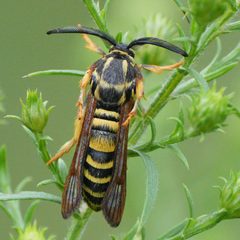
Pennisetia marginatum, commonly known as the Raspberry Crown Borer, is a clearwing moth in the Sesiidae. The is known for its -mimicking appearance and its association with Rubus plants. It is distributed across the Nearctic region, with records from the Canadian prairies and presumably throughout much of its North American range.
Pronunciation
How to pronounce Pennisetia marginatum: //ˌpɛnɪˈsiːtia mɑːrˈdʒɪnətəm//
These audio files are automatically generated. While they are not always 100% accurate, they are a good starting point.
Identification
Clearwing moths in Sesiidae are distinguished from true by wing structure—scaled wing bases and margins with transparent central areas, versus fully membranous wasp wings. Pennisetia marginatum can be separated from other sesiid by genitalia and wing venation patterns. Specific identification from requires examination of morphological details not readily visible in field observations.
Images
Appearance
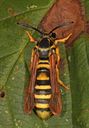
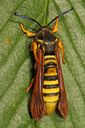
exhibit clearwing moth with transparent wings and -like coloration. The body is typically marked with yellow and black bands, mimicking hymenopteran appearance. Wings lack in central areas, creating the characteristic clearwing effect. The specific epithet 'marginatum' refers to marginal wing markings.
Habitat
Associated with Rubus including raspberry and blackberry plantings, wild bramble patches, and related disturbed or edge habitats where plants occur.
Distribution
Nearctic region. Documented from Alberta, Manitoba, and Saskatchewan in Canada. Distribution extends through North America where suitable Rubus are present.
Seasonality
activity period not specified in available sources; typical for sesiid with larval feeding in crowns and roots.
Diet
Larvae feed internally in crowns and roots of Rubus , particularly raspberry and blackberry. do not feed; they rely on larval reserves.
Host Associations
- Rubus - larval Raspberry and blackberry
Life Cycle
Larvae bore into crowns and roots of Rubus plants, feeding internally and causing damage to the . Development spans two years in typical sesiid fashion, with larvae in host tissue. occurs in spring, with emerging to mate and oviposit on host plants.
Behavior
are and -mimicking in , likely reducing . Females oviposit on stems near the base. Larvae tunnel downward into crowns and roots after hatching.
Ecological Role
As a herbivore on Rubus, the contributes to nutrient cycling through plant tissue consumption. It may serve as prey for and adapted to wood-boring or stem-boring larvae.
Human Relevance
Economic pest of cultivated raspberries and blackberries. Larval tunneling weakens plants, reduces vigor, and can cause plant death in heavy . Management in commercial plantings may be required.
Similar Taxa
- Other Sesiidae (clearwing moths)Share transparent wings and -mimicking appearance; require close examination for separation
- Vespidae (true wasps)Mimicked in appearance; distinguished by wing structure, , and
More Details
Taxonomic note
The was described by Thaddeus William Harris in 1839, an early American entomologist known for work on economically important insects.