
Tinthiinae
Le Cerf, 1917
clearwing moths
Tribe Guides
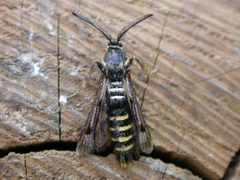
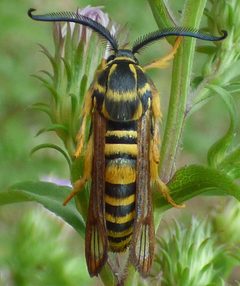
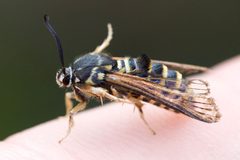
3Tinthiinae is a of clearwing moths ( Sesiidae) established by Ferdinand Le Cerf in 1917. The subfamily comprises 24 organized into four tribes: Tinthiini, Pennisetiini, Paraglosseciini, and Similipepsini. Members are characterized by reduced wing scaling that creates transparent, - or -like appearance—a form of . The group has been documented in approximately 2,400 observations on iNaturalist, indicating moderate but growing recognition among naturalists.
Pronunciation
How to pronounce Tinthiinae: /tɪnˈθiːɪniː/
These audio files are automatically generated. While they are not always 100% accurate, they are a good starting point.
Identification
Tinthiinae exhibit the -wide Sesiidae trait of partially clear wings due to reduced scaling, often with dark borders and . Within the , can be distinguished by specific morphological features: Microsphecia and Tinthia show characteristic wing venation patterns; Pennisetia often have elongated body proportions; Similipepsis displays distinct abdominal banding. Many species closely mimic Hymenoptera in coloration and pattern. Accurate identification to genus or species level typically requires examination of genitalia or detailed wing pattern analysis.
Images
Distribution
The has a broad distribution corresponding to that of Sesiidae, with records from multiple continents. Individual tribes and show varying ranges: Tinthiini is widespread across the Palearctic and Oriental regions; Pennisetiini contains genera distributed in Europe and Asia; Paraglosseciini includes from Australia and the Oriental region; Similipepsini appears more restricted. Specific distribution data for many genera remains limited in published literature.
Similar Taxa
- SesiinaeThe other major of Sesiidae; Tinthiinae differs in genitalia structure and specific wing venation patterns, though both share clearwing .
- TrogoleptiniAnother sesiid tribe/-level group; distinguished by different antennal structure and larval associations.
- Hymenoptera (wasps/hornets)Non-lepidopteran insects that Tinthiinae visually mimic; distinguished by two pairs of wings (vs. one functional pair in ), wing coupling mechanisms, and structure.
More Details
Taxonomic History
The was established by Le Cerf in 1917, with significant revisions in 2001–2003 by Arita and Gorbunov who described multiple new including Cyanophlebia, Bidentotinthia, Tarsotinthia, and Gasterostena. The current tribal structure reflects modern phylogenetic understanding, though some relationships remain under study.
Notable Genera
Pennisetia contains of agricultural concern as stem borers; Tinthia includes some of the most commonly observed clearwing moths in Europe; Zenodoxus is notable for its North American distribution within an otherwise largely Old World .