
Paranthrene dollii
(Neumoegen, 1894)
Doll's clearwing moth, cottonwood clearwing borer, poplar borer moth, Doll's clearwing, cottonwood clearwing, poplar borer
Paranthrene dollii is a clearwing moth in the Sesiidae, native to North America. are active from March through October and may produce multiple per season. The is notable for its -mimicking appearance and its larval association with poplar and willow trees, earning it the 'cottonwood clearwing borer.'
Pronunciation
How to pronounce Paranthrene dollii: //pæˈɹænθɹə.ni ˈdɒl.i.aɪ//
These audio files are automatically generated. While they are not always 100% accurate, they are a good starting point.
Identification
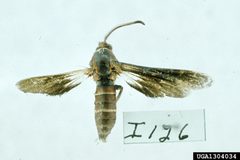
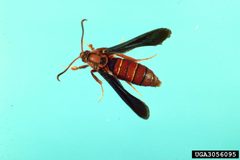
The combination of clear wings with dark borders, -mimicking body shape, and association with Populus and Salix distinguishes this from other clearwing moths. The specific epithet honors entomologist Henry Doll. can be separated from similar Paranthrene species by geographic range and period; larvae require host association or molecular identification for definitive determination.
Images
Appearance
have a wingspan of approximately 37 mm. As a member of Sesiidae, the exhibits clearwing with reduced wing scaling that exposes the membranous portions, creating a -like appearance. The body is typically dark with contrasting pale or yellowish markings.
Habitat
Associated with riparian and wetland where trees occur. Larvae develop within the wood of living or stressed poplar and willow trees.
Distribution
Nearctic region; recorded from North America. Specific locality records include regions where Populus and Salix are native.
Seasonality
are active from March to October, with potential for multiple within this extended season.
Diet
Larvae feed internally on the wood of Populus (poplar, cottonwood) and Salix (willow) . feeding habits are not documented.
Host Associations
- Populus - larval poplar, cottonwood
- Salix - larval willow
Life Cycle
Larvae are wood-borers that develop within the trunks and branches of trees. The extended season from March to October suggests either overlapping or multiple cohorts emerging at different times. Specific details of and stages are not documented.
Behavior
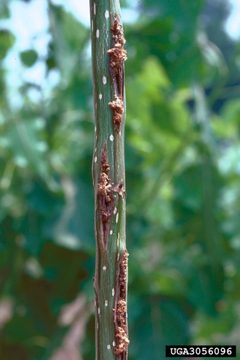
are and exhibit -mimicking typical of Sesiidae. Larvae bore into tree wood, causing internal damage.
Ecological Role
As a wood-boring insect, larvae contribute to nutrient cycling in riparian by breaking down woody material. The -mimicking appearance of may reduce pressure through .
Human Relevance
Larvae can be considered minor pests when they infest ornamental or economically valuable poplar and willow plantings, though they are not a major forestry pest. The is of interest to lepidopterists due to its clearwing and mimicry.
Similar Taxa
- Other Paranthrene speciesSimilar clearwing and mimicry; require examination of genitalia or association for separation
- Sesiidae in generalShared characteristics of clear wings and mimicry; -level characters needed for identification
More Details
Etymology
The specific epithet 'dollii' honors Henry Doll, an entomologist who contributed to the study of North American Lepidoptera.
Original description
Originally described as Sciapteron dollii by Neumoegen in 1894 before transfer to Paranthrene.