
Carmenta giliae
(Edwards, 1881)
Carmenta giliae is a clearwing moth in the Sesiidae, described by Henry Edwards in 1881. It occurs in montane meadows of western North America, from Alberta and British Columbia south to Arizona and New Mexico. The has a wingspan of approximately 25 mm. Larvae are root borers in wild Geranium species.
Pronunciation
How to pronounce Carmenta giliae: //karˈmɛn.ta ˈɡiː.li.ae//
These audio files are automatically generated. While they are not always 100% accurate, they are a good starting point.
Identification
Distinguished from other clearwing moths by geographic range and association with montane meadow at mid-to-high elevations. Specific diagnostic features separating it from in the Carmenta are not documented in available sources.
Images
Appearance
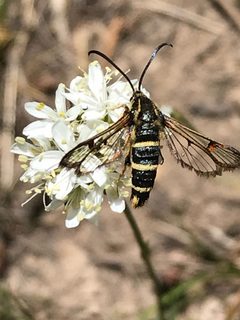
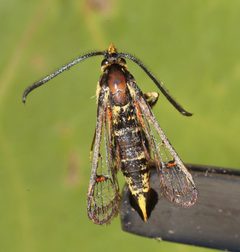
Small clearwing moth with wingspan approximately 25 mm. As a member of Sesiidae, it likely exhibits -mimicry with partially transparent wings due to reduced scaling, though specific coloration patterns are not detailed in available sources.
Habitat
Mid-to-high elevation montane meadows in western North America.
Distribution
Western Alberta to north-western British Columbia, southward through the Rocky Mountain region to Arizona and New Mexico.
Diet
Larvae bore in roots of wild Geranium . feeding habits are not documented.
Host Associations
- Geranium - larval wild ; larvae bore in roots
Life Cycle
Larval stage bores in roots of plants. and timing are not documented.
Ecological Role
As a root-boring herbivore, larvae likely influence plant in montane meadow . Specific ecological impacts are not documented.
Similar Taxa
- Other Carmenta speciesMany share similar clearwing and western North American distribution; precise differentiation requires examination of genitalia or other subtle characters not detailed in general sources.
More Details
Taxonomic history
Originally described as Aegeria giliae by Henry Edwards in 1881, later transferred to Carmenta.