
Sesia apiformis
(Clerck, 1759)
Hornet Moth, Hornet Clearwing
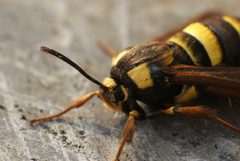
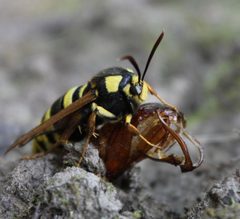
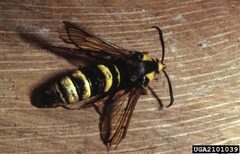
Sesia apiformis is a large clearwing moth ( Sesiidae) native to Europe and the Middle East, now introduced to North America. It exhibits striking of (Hymenoptera), with bold black and yellow abdominal banding and yellow and tegulae. are active from mid-June to July. Females are larger than males and remain stationary on tree trunks to emit , while smaller males actively seek mates. The is associated with poplar trees, where larvae tunnel in lower trunk and root wood for two to three years.
Pronunciation
How to pronounce Sesia apiformis: /ˈsiːzɪə əˈpɪfɔːrmɪs/
These audio files are automatically generated. While they are not always 100% accurate, they are a good starting point.
Identification
Distinguished from Sesia bembeciformis by yellow (not orange-brown) and tegulae. Distinguished from actual (Hymenoptera) by : two pairs of scaled wings (though largely transparent), filamentous , and lack of constricted waist. Exit holes in poplar trunks (~1 cm diameter) with protruding pupal indicate presence.
Images
Appearance
Large clearwing moth with transparent wings due to reduced scaling. Bold black and yellow transverse stripes on . Yellow and tegulae (shoulder plates). Distinguished from similar S. bembeciformis by these yellow markings; S. bembeciformis has orange-brown head and tegulae. Wingspan substantial among sesiids.
Habitat
Woodland . Closely associated with poplar trees, specifically tunneling in wood of lower trunk and roots below bark level. Requires trees of Populus nigra or P. tremula.
Distribution
Native to western and central Europe, with scattered records extending east to central Russia. Also native to Middle East. Introduced to North America, established on East coast and Great Lakes region. In United Kingdom, most common in East of England; classified as Nationally Scarce.
Seasonality
period mid-June to July. Larval development spans at least two to three years within wood.
Diet
Larvae feed on wood of black poplar (Populus nigra) and aspen (Populus tremula). do not feed; mouthparts reduced or non-functional.
Host Associations
- Populus nigra - larval black poplar
- Populus tremula - larval aspen
Life Cycle
laid on trees. Larvae tunnel in wood of lower trunk and roots for minimum two years, possibly three. Larvae create exit hole (~1 cm diameter) prior to . Pupa uses specialized spines (adminicula) to maneuver close to exit hole. emerges through exit hole; pupal protrude slightly from hole, providing visible sign of .
Behavior
Females remain stationary on tree trunks, emitting to attract mates. Males actively fly to detect female pheromones; upon locating female, male positions himself upside down beneath her for copulation. rarely observed despite large size. Strong with -like appearance that deters .
Ecological Role
Phytophagous wood-borer. Primarily attacks stressed, weakened, or drought-impacted trees rather than healthy individuals. Limited evidence of significant damage to UK poplar ; drought-stressed trees can recover even with larval presence. Role in as decomposer of compromised wood.
Human Relevance
Subject of concerns regarding poplar plantations; historically accused of causing serious damage to hybrid black poplar trees, though research indicates primary impact on already-stressed trees. sequenced (Wellcome Sanger Institute, 2024). Elicits strong emotional response in observers due to mimicry. Unforgettable from tree trunks noted by observers.
Similar Taxa
- Sesia bembeciformisOverlapping distribution and similar clearwing ; distinguished by orange-brown (not yellow) and tegulae
- Sesia tibialisNative North American ; may compete with introduced S. apiformis in introduced range
- Vespa crabro (European hornet) model; distinguished by Hymenoptera features including constricted waist, elbowed , and two pairs of membranous wings with different venation
Misconceptions
Historical attribution of serious poplar tree damage to this ; current evidence indicates larvae primarily colonize trees already weakened by drought or water table impacts, with limited independent capacity to damage healthy .
More Details
Genomic resources
Reference assembly available: 546.8 Mb, 31 , 16,358 protein-coding genes (Wellcome Sanger Institute, 2024)
Pheromone chemistry
Female contains two main chemical components necessary for male attraction
Conservation status
Nationally Scarce in United Kingdom; most frequent in East of England