
Zeuzera pyrina
(Linnaeus, 1761)
leopard moth, wood leopard moth
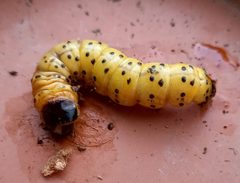
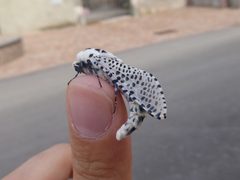
Zeuzera pyrina is a medium-sized wood-boring in the Cossidae, commonly known as the leopard moth or wood leopard moth. are highly distinctive with white wings marked by numerous black spots, giving the its . The larvae are pests that tunnel into the wood of fruit trees and other deciduous , causing significant economic damage in orchards worldwide. The species is native to Europe, North Africa, and Asia, and has been introduced to the northeastern United States.
Pronunciation
How to pronounce Zeuzera pyrina: //zuˈzɛra pɪˈraɪnə//
These audio files are automatically generated. While they are not always 100% accurate, they are a good starting point.
Identification
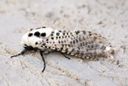
Distinguished from other Cossidae by the distinctive white wings with dense black spotting arranged in rows along the . The six black spots on the white furry are diagnostic. Males have broader, more feathery than females. The combination of spotted forewings and translucent hindwings (except anal area) separates this from superficially similar noctuids or other wood . Larval tunnels are extensive, reaching up to 50 cm in length, with coarse ejected from entrance holes.
Images
Habitat
Woodland, gardens, and orchards. Strongly associated with areas containing suitable trees, particularly fruit tree orchards and olive groves. In Egypt, found in both old cultivated orchards and newly reclaimed agricultural lands.
Distribution
Native to Europe (excluding Ireland), northern Africa (Algeria, Egypt, Libya, Morocco, Tunisia), and Asia (Afghanistan, Cyprus, India, Iran, Iraq, Israel, Japan, Jordan, Korea, Lebanon, Saudi Arabia, Sri Lanka, Syria, Taiwan, Turkey). Introduced to northeastern United States prior to 1879; established in Maine, Pennsylvania, Tennessee, and Texas.
Seasonality
fly from June to September, with timing varying by location. In Egypt, pupal occurs from late May to late July, with adult emergence from mid-June to early August. Larval activity continues year-round within wood, with peak fungal of larvae occurring in winter months (December–February).
Diet
Larvae feed internally on the wood of various deciduous trees and shrubs. Recorded include apple (Malus domestica), pear (Pyrus communis), cherry (Prunus avium), plum (Prunus domestica), olive (Olea europaea), walnut (Juglans regia), fig (Ficus), willow (Salix), poplar (Populus), and other stone fruit and ornamental trees.
Host Associations
- Malus domestica - larval apple; significant orchard pest
- Pyrus communis - larval pear
- Prunus avium - larval cherry
- Prunus domestica - larval plum
- Olea europaea - larval olive; particularly susceptible, trees can be killed by larval boring
- Juglans regia - larval walnut; rates up to 16% documented
- Ficus - larval fig
- Salix - larval willow
- Populus - larval poplar
- Beauveria bassiana - fungus; causes natural with seasonal
- Steinernema carpocapsae - ; high biocontrol potential
- Heterorhabditis indica -
- Elachertus nigritulus - parasitic wasp used in
Life Cycle
laid on bark of susceptible trees. Larvae bore into wood and feed internally for two to three years, creating extensive tunnels up to 50 cm long, before emerging to pupate under bark. occurs under bark; emerge and fly during summer months. Larval development includes at least six instars based on studies.
Behavior
Larvae exhibit highly adaptable feeding , infesting both healthy and weakened trees. Extensive wood-boring creates galleries that disrupt water and nutrient transport, causing wilting, reduced growth, and tree mortality. are . Larvae demonstrate high adaptive capacity to chemical control measures, complicating management efforts.
Ecological Role
As a primary wood-borer, larvae physically alter tree structure and function, creating entry points for secondary and pests. Weakened trees become more susceptible to other . Serves as host for diverse natural enemies including , predatory insects, spiders, , and fungi, contributing to complexity in orchard and woodland .
Human Relevance
Major pest of fruit tree worldwide. Causes significant economic damage through larval tunneling, with documented tree death rates of 17.83% in apple orchards. Management relies on integrated approaches: monitoring with delta traps, pruning infested branches, using and entomopathogens, and judicious chemical application. Subject of research for biocontrol development using and fungi.
Similar Taxa
- Zeuzera biebingeriTreated as Z. pyrina biebingeri by some sources, but mostly treated as valid ; distinction requires taxonomic expertise
- Other CossidaeDistinguished by diagnostic spotted wing pattern and thoracic markings; most other cossids lack distinct spotted forewings with rows of spots along
Sources and further reading
- BugGuide
- Wikipedia
- GBIF taxonomy match
- iNaturalist taxon
- NCBI Taxonomy
- Catalogue of Life
- Zeuzera pyrina . [Distribution map].
- Zeuzera pyrina: the threatening leopard moth damaging fruit trees
- Seasonal prevalence and histopathology of Beauveria bassiana infecting larvae of the leopard moth, Zeuzera pyrina L. (Lepidoptera: Cossidae)
- REARING FRUIT BORERS ON NATURAL HOSTS AND ARTIFICIAL MEDIUM DIETS: 1-ZEUZERA PYRINA L. (LEPIDOPTERA: COSSIDAE)
- Biocontrol potential of four native entomopathogenic nematodes against Zeuzera pyrina L.(Lepidoptera: Cossidae) in the Willow trees (Salix spp.)
- Natural Host Rearing and some Biological Aspects of the Leopard Moth Zeuzera pyrina L. (Lepidoptera: Cossidae) on Poplar Trees (Populus Sp.) (Malpighiales salicaceae) in Egypt
- Spatio-temporal distribution and mass-trapping of leopard moth, Zeuzera pyrina in walnut orchards
- Synergistic Bioconversion of Date Palm Leaves Into Ruminant Feed by a Leopard Moth (Zeuzera pyrina L.) Gut Bacterial Consortium and Nutrient Stimulators.