
Prochoreutis inflatella
(Clemens, 1863)
skullcap skeletonizer moth
A small choreutid (wingspan 9–11 mm) found in eastern North America. are active from June through September with multiple per year. Larvae are feeders on Scutellaria , particularly Scutellaria lateriflora, and appear in March shortly after plant . The species constructs a distinctive , multi-layered white silk cocoon for .

Pronunciation
How to pronounce Prochoreutis inflatella: /proʊˌkɔr.iˈuː.tɪs ɪn.fləˈtɛl.lə/
These audio files are automatically generated. While they are not always 100% accurate, they are a good starting point.
Identification
Distinguished from other small by combination of extremely small size (9–11 mm wingspan), eastern North American distribution, and association with Scutellaria plants. The Prochoreutis contains multiple ; precise identification to species level may require examination of genitalia or larval host association. The multi-layered white silk cocoon is a notable larval characteristic.
Images
Appearance
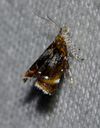
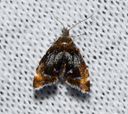
Very small with wingspan of 9–11 mm. Overall appearance typical of Choreutidae: compact body, relatively broad wings held tent-like or flat at rest. Coloration and pattern details not specified in available sources.
Habitat
Associated with supporting Scutellaria , particularly Scutellaria lateriflora (mad-dog skullcap), which typically occurs in moist woodland edges, stream banks, and shaded meadows.
Distribution
Eastern North America. Specific records include Vermont and broader US distribution in the eastern region.
Seasonality
active June to September. Multiple per year. First larvae appear in March, shortly after plant begins growth.
Diet
Larvae feed exclusively on Scutellaria , including Scutellaria lateriflora. feeding habits not documented.
Host Associations
- Scutellaria lateriflora - larval primary ; larvae appear shortly after plant begins growth in March
- Scutellaria - larval -level association
Life Cycle
Complete with multiple per year. Larvae emerge in March, feeding on young Scutellaria foliage. occurs in a , multi-layered cocoon constructed of white silk. emerge from June through September.
Behavior
Larvae are early-season , timing to coincide with plant growth initiation. The construction of a multi-layered silk cocoon represents a distinctive pupal .
Ecological Role
Herbivore specializing on Scutellaria ; likely has minimal broader impact due to narrow range and small size. May serve as prey for .
Human Relevance
No documented economic or medical significance. 'skullcap skeletonizer' refers to larval feeding damage on plant foliage. Occasionally encountered by botanists and enthusiasts in eastern North America.
Similar Taxa
- Other Prochoreutis speciesSimilar size and general ; may require genitalia dissection or plant association for definitive identification
- Other Choreutidae members share compact body form and small size; wing patterns and associations differ
More Details
Cocoon structure
The pupal cocoon is described as (spindle-shaped) and multi-layered, constructed from white silk. This structure may provide protection against environmental conditions or .
Early larval phenology
Larvae appear in March, notably early in the growing season and closely synchronized with plant . This timing suggests to exploit ephemeral young foliage.