
Agrius cingulata
Fabricius, 1775
pink-spotted hawkmoth, sweetpotato hornworm
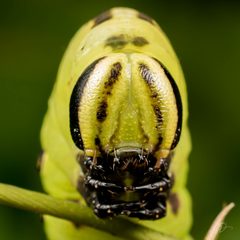
Agrius cingulata is a large sphingid with broad neotropical distribution extending northward through migratory . are nectar feeders with exceptionally long , while larvae are robust hornworms that feed voraciously on Convolvulaceae, particularly sweet potato (Ipomoea batatas), causing significant agricultural damage. The has been documented as a "nectar thief" of rare orchids, removing nectar without providing pollination services.
Pronunciation
How to pronounce Agrius cingulata: /ˈæɡriəs ˌsɪŋɡjʊˈlɑːtə/
These audio files are automatically generated. While they are not always 100% accurate, they are a good starting point.
Identification
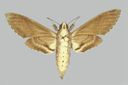
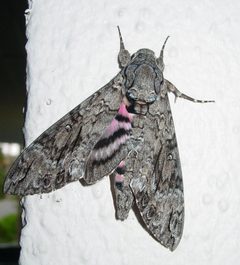
Distinguished from similar sphingids by combination of pink abdominal bands and pink-based hindwings. Manduca lack pink coloration and have different wing patterns. Agrius convolvuli has more uniform gray-brown coloration without distinct pink markings. may be separated from other Agrius by specific wing pattern elements, though detailed genitalia examination may be required for certainty.
Images
Habitat
Occurs in diverse from tropical and subtropical regions through temperate zones during summer months. Associated with agricultural areas, gardens, and natural areas where plants (Convolvulaceae) occur. Migratory found in northern ranges during warm seasons.
Distribution
Primarily neotropical, ranging from South America (Brazil, Argentina, Patagonia, Falkland Islands) through Central America, Caribbean, and Mexico. Northward extends to Canada. Established in Galápagos Islands, Hawaii, and recently in West Africa (possibly from Brazil) and Cape Verde. Vagrant records from western Europe (Portugal, United Kingdom).
Seasonality
active year-round in tropical regions. Northward occurs during warmer months; adults present in northern United States and Canada primarily summer through early fall. Larval activity coincides with plant growing season.
Diet
feed on nectar from deep-throated flowers including moonflower (Calonyction aculeatum), morning glories (Convolvulus ), and petunias (Petunia species). Larvae feed on sweet potato (Ipomoea batatas), Datura species, and other Convolvulaceae; prefer young and mature leaves, but will feed on stems and flowers when leaves are unavailable.
Host Associations
- Ipomoea batatas - larval food plantsweet potato; major agricultural pest
- Datura - larval food plantmultiple
- Calonyction aculeatum - nectar sourcemoonflower
- Convolvulus - nectar sourcemorning glories
- Petunia - nectar sourcemultiple
- Platanthera praeclara - nectar sourcewestern prairie fringed orchid; nectar thief, no pollination services provided
Life Cycle
Laboratory studies at 28±4°C, 70±4% RH, 12L:12D indicate: incubation 6±0.5 days; larval duration 42±1 days (five instars); 26±1 days; total development egg to approximately 73 days. Pupation occurs in soil. Multiple per year in tropical regions; single or partial generations in temperate zones depending on timing.
Behavior
, strong fliers capable of long-distance . Feed while hovering at flowers using exceptionally long . Documented as "nectar thieves" of Platanthera praeclara—removing nectar without contacting reproductive structures or transferring pollen. Larvae feed diurnally and nocturnally, highly mobile between plants. When disturbed, larvae may thrash or drop from plants.
Ecological Role
Larval herbivore; significant agricultural pest of sweet potato causing yield reduction. of some plant , though nectar thievery documented for orchids. Prey for various vertebrate and . likely important in , though specific natural enemies not documented in sources.
Human Relevance
Major pest of sweet potato globally. Larval feeding defoliates plants and reduces tuber yield. Management through and . occasionally encountered in orchid conservation contexts as problematic nectar thieves. Subject of entomological study for patterns and plant-insect interactions.
Similar Taxa
- Agrius convolvuliSimilar larval use and ; lacks pink abdominal bands and pink hindwing bases; has more uniform gray-brown coloration; shorter development time (55 days vs. 73 days to )
- Manduca quinquemaculataSimilar size and general form; lacks pink coloration; has five pairs of with distinctive ; different wing venation and pattern
- Manduca sextaSimilar size and ecological role; tomato/tobacco hornworm; lacks pink markings; has different abdominal pattern with paired lateral spots rather than bands
More Details
Nectar larceny
Documented as one of two hawk moth exhibiting "nectar thievery" at Platanthera praeclara (western prairie fringed orchid) in North Dakota. have more than twice the length of orchid spurs, allowing nectar removal without contacting reproductive structures. No pollen transfer observed. Represents conservation concern for threatened orchid if northward increases.
Recent range expansion
Established recently detected in West Africa and Cape Verde, possibly originating from Brazil. Vagrant records from western Europe suggest long-distance capability, though breeding status in these regions uncertain.
Laboratory rearing parameters
Developmental data derived from controlled laboratory conditions (28±4°C, 70±4% RH, 12L:12D); field development rates likely vary with temperature and plant quality.
Sources and further reading
- BugGuide
- Wikipedia
- GBIF taxonomy match
- iNaturalist taxon
- NCBI Taxonomy
- Catalogue of Life
- Nectar Robbers and Thieves Are Harming Rare Orchids in North Dakota
- 2022 Six-State Insect Collecting Trip iReport | Beetles In The Bush
- Life cycle, feeding behavior and nature of damage of sweet potato leaf moth, Agrius cingulata (Fabricius) and Agrius Convolvuli (Linnaeus) (Lepidoptera: Sphingidae)