
Agrius
Hübner, 1819
sweetpotato hornworms, convolvulus hawkmoths
Species Guides
1- Agrius cingulata(pink-spotted hawkmoth)
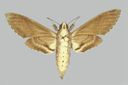
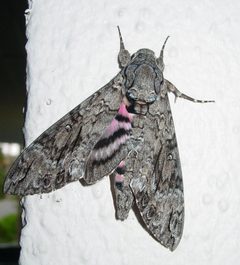
Agrius is a of hawkmoths (Sphingidae) containing approximately 3–5 , most notably Agrius cingulata (sweetpotato ) and Agrius convolvuli (convolvulus hawkmoth). These are large, robust with distinctive pinkish abdominal bands. The larvae are economically significant agricultural pests, particularly of sweet potato (Ipomoea batatas) and related Convolvulaceae. are powerful fliers capable of long-distance , with some undertaking transcontinental movements. The genus occurs across tropical and subtropical regions worldwide, with some species extending into temperate zones during summer months.
Pronunciation
How to pronounce Agrius: //ˈæɡriəs//
These audio files are automatically generated. While they are not always 100% accurate, they are a good starting point.
Identification
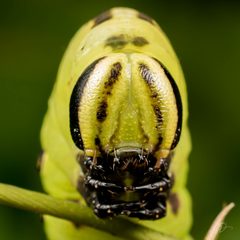
Distinguished from the related Manduca by the presence of pink or reddish bands on the (absent in most Manduca). Forewing pattern more uniform and less contrasting than in Manduca. Larvae identified by diagonal body stripes and horn coloration; Manduca larvae have oblique lateral stripes and different horn . Agrius convolvuli has more extensive pink coloration on abdomen than A. cingulata. Genitalia examination may be required for definitive identification in some cases.
Images
Habitat
Tropical and subtropical agricultural lands, gardens, and natural areas where plants (Convolvulaceae) occur. frequent a variety of including coastal areas, woodlands, and urban gardens during . Larvae occur on cultivated sweet potato fields and weedy Convolvulaceae in disturbed habitats.
Distribution
Pantropical and subtropical distribution with extensions into temperate regions. Agrius convolvuli: widespread across Africa, southern Europe, Asia, Australia, and Pacific islands; migrates northward into Europe and northern Asia during summer. Agrius cingulata: Americas from Argentina to southern Canada, Caribbean, migratory in North America. Records from northern Europe and North America represent seasonal migrants rather than established .
Seasonality
Year-round breeding in tropical regions; seasonal appearance in temperate zones during summer months (May–September in northern hemisphere). peaks vary by region: late spring to early autumn in Europe and North America. Multiple per year in favorable climates.
Diet
Larvae feed on Convolvulaceae, primarily Ipomoea batatas (sweet potato), Ipomoea spp. (morning glories), Convolvulus arvensis (field bindweed), and related . feed on nectar from various flowers with long corolla tubes; recorded visiting Nicotiana, Petunia, and other deep-throated flowers. Some adult exhibit nectar thievery , accessing nectar without pollination.
Host Associations
- Ipomoea batatas - primary sweet potato, major agricultural pest
- Ipomoea spp. - morning glories and related
- Convolvulus arvensis - field bindweed
- Arachis hypogaea - occasional groundnut, secondary
- Lablab purpureus - Indian bean
- Vigna spp. - cowpeas and relatives
- Phaseolus spp. - beans
Life Cycle
Complete . laid singly on plant leaves. Larvae pass through 5–6 instars, feeding voraciously on leaves; mature larvae may feed on stems and flowers when leaf tissue depleted. Larval duration: 24–42 days depending on and temperature. occurs in soil or leaf litter; pupal duration 14–26 days. emerge and may migrate before breeding. Total time: 55–73 days under laboratory conditions (28°C). Multiple generations annually in tropical climates; single or partial second generation in temperate zones.
Behavior
are powerful, fast fliers capable of sustained hovering . activity pattern with and nocturnal flight; attracted to artificial light sources. Migratory well-documented: A. convolvuli undertakes regular northward into Europe from Mediterranean breeding grounds; A. cingulata migrates northward in North America. Migration appears wind-assisted but directed, not purely passive . Adults may enter temporary reproductive during migration. Larvae are solitary feeders with thrashing defensive behavior when disturbed.
Ecological Role
Significant agricultural pest causing direct damage to sweet potato and related crops through larval defoliation. serve as of some deep-throated flowers, though nectar thievery reduces pollination . Larvae contribute to nutrient cycling through herbivory in natural systems. Prey for various , , and birds. contributes to cross-regional and connectivity.
Human Relevance
Major pest of sweet potato globally; economic impact includes yield reduction and control costs. Subject to programs including using (Cotesia spp.) and Bacillus thuringiensis. Used as model organism in physiological and neurological research, particularly for studies of muscle metabolism, feeding , and . sometimes encountered by gardeners and naturalists; larvae occasionally mistaken for tomato hornworm (Manduca quinquemaculata).
Similar Taxa
- ManducaSimilar large gray-brown sphingid with robust bodies; distinguished by absence of pink abdominal bands and different larval stripe pattern
- AcherontiaDeath's- hawkmoths share large size and some coloration; distinguished by distinctive thoracic pattern and skull-like marking
- HippotionRelated sphingid with similar ; generally smaller with different wing pattern
More Details
Nectar Thievery
Research in North Dakota documented Agrius cingulata as a 'nectar thief' of the threatened western prairie fringed orchid (Platanthera praeclara), using its long to access nectar without pollinating the flower. This , shared with Manduca quinquemaculata, may impact rare plant conservation where hawkmoth extends beyond typical breeding ranges.
Feeding Regulation
Studies have identified (HemaP) in A. convolvuli that modulate feeding motivation, demonstrating conserved physiological mechanisms across Lepidoptera for regulating foraging .
Migration Ecology
Buglife documentation recognizes A. convolvuli as a notable long-distance migrant among European insects, with regularly crossing the Mediterranean and moving northward into northern Europe during summer.
Sources and further reading
- BugGuide
- GBIF taxonomy match
- iNaturalist taxon
- NCBI Taxonomy
- Catalogue of Life
- Nectar Robbers and Thieves Are Harming Rare Orchids in North Dakota
- Insect Migration (Part 1) - Buglife Blog - Buglife
- Mudo Pryfed (Rhan 1) - Buglife Blog - Buglife
- Acanthaceae | Beetles In The Bush
- Agrius convolvuli . [Distribution map].
- Agrius convolvuli . [Distribution map].
- Life cycle, feeding behavior and nature of damage of sweet potato leaf moth, Agrius cingulata (Fabricius) and Agrius Convolvuli (Linnaeus) (Lepidoptera: Sphingidae)
- Oviposition behavior of the sweet potato hornworm, Agrius convolvuli (Lepidoptera ; Sphingidae), as analysed using an artificial leaf
- A hemolymph major anionic peptide, HemaP, motivates feeding behavior in the sweetpotato hornworm, Agrius convolvuli