
Actias
Leach, 1815
Moon Moths, Asian-American Moon Moths
Species Guides
1- Actias luna(Luna Moth)
Actias is a of Saturniid commonly known as moon moths, distributed across Asia and the Americas. The genus is distinguished by elongated hindwing tails and includes well-known such as the Luna moth (A. luna) of North America and the Spanish moon moth (A. isabellae) of Europe. moths lack functional mouthparts, limiting their lifespan to several days to one week after . Caterpillars feed on leaves of various woody plants including sweetgum, pine, hickory, walnut, and birch.
Pronunciation
How to pronounce Actias: //ˈæk.ti.əs//
These audio files are automatically generated. While they are not always 100% accurate, they are a good starting point.
Identification
Distinguished from other Saturniidae by the combination of extremely long hindwing tails and pale green or yellow ground color. Similar Copiopteryx, Argema, and Eudaemonia share tailed hindwings but differ in wing pattern, tail proportions, and geographic distribution. Actias tails are typically longer and more slender than those of Argema. Forewing shape and eyespot placement differ from Copiopteryx.
Images
Appearance
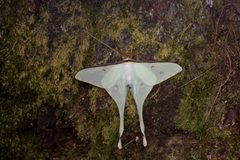
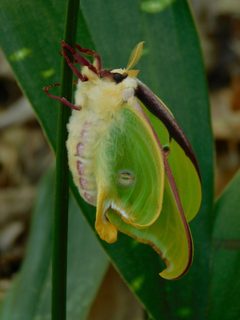
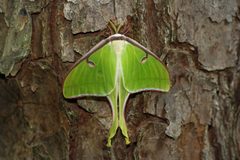
Large-bodied with broad, pale green or yellowish wings. Hindwings bear extremely elongated, tapering tails that can exceed the length of the forewings. Wings often display eyespots or translucent patches. are strongly bipectinate (feathery) in males, particularly pronounced and used for detecting female . Body is robust with reduced mouthparts in . Wing margins may be angular or tailed depending on .
Habitat
Forest and woodland , ranging from deciduous hardwood forests to coniferous and mixed woodlands. Associated with tree presence. frequently encountered near artificial lights adjacent to forested areas.
Distribution
Holarctic and Oriental regions. North American (e.g., A. luna) range from Mexico to southern Canada. Asian species occur from India and the Andaman Islands through China, Taiwan, and Japan. European species (A. isabellae) restricted to Spain and France with an isolated Alpine (A. isabellae galliaegloria).
Seasonality
typically occurs in spring and early summer, with timing varying by latitude and elevation. Northern generally (one annually); southern populations may produce two or three annually. Adults are .
Diet
Larvae feed on leaves of woody angiosperms and gymnosperms including sweetgum (Liquidambar), pine (Pinus), hickory (Carya), walnut (Juglans), birch (Betula), sumac (Rhus), and persimmon (Diospyros). lack functional mouthparts and do not feed.
Host Associations
- Liquidambar styraciflua - larval sweetgum
- Pinus sylvestris - larval Scots pine; primary for A. isabellae galliaegloria
- Carya - larval hickory
- Juglans - larval walnut
- Betula - larval birch
- Rhus - larval sumac
- Diospyros - larval persimmon
Life Cycle
Holometabolous. laid on plant leaves. Larvae pass through five instars, feeding externally on foliage. Mature larvae descend to ground and spin silken cocoons incorporating leaves for camouflage and protection. occurs within cocoon, with emerging after variable periods depending on climate. stage is typically pupal within cocoon.
Behavior
are and strongly attracted to artificial light sources, a that frequently results in mortality from , desiccation, or human disturbance. Males use feathery to detect female . orientation appears to use celestial light sources; artificial lights cause disoriented spiral flight patterns. Adults are incapable of feeding.
Ecological Role
Larvae function as folivores in forest , consuming leaves of and understory trees. serve as prey for bats, birds, and other . Cocoons and larvae are parasitized by braconid wasps including Cotesia . Contributes to nutrient cycling through herbivory and as prey .
Human Relevance
Popular in entomological education and outreach due to striking appearance. Subject of ecological research on light pollution impacts on insects. A. isabellae is protected under the EU Directive. Culturally significant in art and tattoo design. sequencing of A. isabellae conducted for conservation research.
Similar Taxa
- ArgemaShares elongated hindwing tails but differs in tail , wing pattern, and African/Madagascan distribution
- CopiopteryxSimilar tailed hindwings but differs in forewing shape, eyespot configuration, and Neotropical distribution
- EudaemoniaConvergent tailed hindwing but distinct wing venation and African distribution
More Details
Light pollution vulnerability
Strong positive makes highly susceptible to mortality from artificial lighting. Parking lot and security lights frequently attract and trap individuals, disrupting mate location and reducing reproductive success.
Conservation status
Alpine A. isabellae galliaegloria exhibits extremely low genetic diversity and projected contraction by 2050 due to climate change and plant decline.
Sources and further reading
- BugGuide
- Wikipedia
- GBIF taxonomy match
- iNaturalist taxon
- NCBI Taxonomy
- Catalogue of Life
- Bohart Museum: This Bug's for You | Bug Squad
- A Buggy New Year! | Bug Squad
- Hey There, Pumpkin! Prey Tell, Is That a Praying Mantis? | Bug Squad
- The Art of Loving Insects: Bohart Museum-Style | Bug Squad
- Be on the lookout for Lunas: Luna moths, Actias luna — Bug of the Week
- Saving Hercules and a moon moth: Hercules beetle, Dynastes tityus, and Luna moth, Actias luna — Bug of the Week
- WF.ACTIAS: A workflow for a better integration of biodiversity data from diverse sources
- Peer Review Report For: ERGA-BGE genome of the Spanish moon moth Actias isabellae Graells, 1849: a nocturnal lepidopteran protected by the Habitats Directive [version 2; peer review: 2 approved]
- Peer Review Report For: ERGA-BGE genome of the Spanish moon moth Actias isabellae Graells, 1849: a nocturnal lepidopteran protected by the Habitats Directive [version 1; peer review: 1 approved, 1 approved with reservations]
- Peer Review Report For: ERGA-BGE genome of the Spanish moon moth Actias isabellae Graells, 1849: a nocturnal lepidopteran protected by the Habitats Directive [version 1; peer review: 1 approved, 1 approved with reservations]
- ON SOME OF OUR COMMON INSECTS.: THE LUNA MOTH—Actias luna Linn
- Genetic erosion and projected habitat loss in the protected Alpine moth Actias isabellae galliaegloria (Lepidoptera: Saturniidae)
- The host plant and pre-imaginal stages of Actias callandra (Saturniidae) from the Andaman Islands, India
- Charge Dependent Distribution of Endogenous Proteins within Vitellogenic Ovarian Follicles of Actias luna
- A rapidly progressing, deadly disease of Actias selene (Indian moon moth) larvae associated with a mixed bacterial and baculoviral infection
- A new species of Cotesia Cameron (Hymenoptera, Braconidae, Microgastrinae) reared from the hickory horned devil, Citheronia regalis, and luna moth, Actias luna, in east Texas
- A new species of Cotesia Cameron (Hymenoptera, Braconidae, Microgastrinae) reared from the hickory horned devil, Citheronia regalis, and luna moth, Actias luna, in east Texas
- Adaptation variations of the Taiwanese Chinese moon moth Actias ningpoana ningtaiwana to different host plants
- Evolution of Highly Repetitive Silk Genes in the Luna Moth, Actias luna.
- ERGA-BGE genome of the Spanish moon moth Actias isabellae Graells, 1849: a nocturnal lepidopteran protected by the Habitats Directive.