
Hemileuca maia
Drury, 1773
buck moth
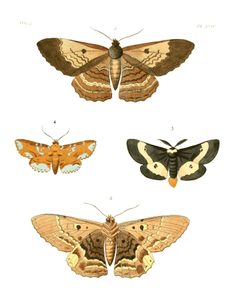
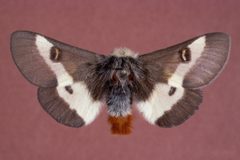
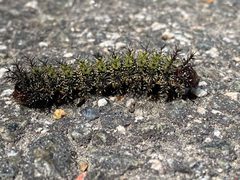
Hemileuca maia, commonly known as the buck , is a saturniid moth native to eastern North America. The has expanded its range northward in recent decades. are and do not feed. Larvae feed gregariously on oak foliage and possess urticating spines capable of causing painful reactions in humans and animals. The species has one per year, with on twigs. Recent taxonomic research has clarified the complex evolutionary relationships within the H. maia-nevadensis , elevating several previously synonymized to species status.
Pronunciation
How to pronounce Hemileuca maia: /ˌhɛmɪˈljuːkə ˈmaɪə/
These audio files are automatically generated. While they are not always 100% accurate, they are a good starting point.
Identification
Hemileuca maia can be distinguished from related Hemileuca by geographic distribution and, where overlapping, by subtle morphological and genetic differences. Within the H. maia-nevadensis , H. maia sensu stricto occupies eastern North America, while Great Plains previously identified as H. nevadensis are now recognized as distinct species (Hemileuca latifascia). Males of H. maia, H. grotei, and H. nevadensis show no attraction to Argiope aurantia lures, unlike males of H. magnifica and H. hera which are strongly attracted.
Images
Habitat
Oak-dominated forests and urban/suburban areas with oak trees.
Distribution
Eastern North America, ranging from peninsular Florida to New England, and westward to Texas and Kansas. The has expanded its range northward in recent decades.
Seasonality
One per year. emerge in late summer. overwinter on twigs and hatch in spring.
Diet
Larvae feed exclusively on oak (Quercus) foliage. do not feed.
Host Associations
- Quercus - primary larvae feed gregariously on oak leaves
Life Cycle
are deposited in masses on oak twigs and overwinter. Larvae hatch in spring and develop through multiple instars, feeding gregariously. occurs in soil. emerge in late summer, mate, and females deposit eggs for the next .
Behavior
Larvae feed gregariously. are and fast-flying, often flying well above the vegetation layer.
Ecological Role
Defoliator of oak trees; can cause significant tree stress and mortality with repeated defoliation. Urticating larvae pose health risks to humans, pets, and livestock.
Human Relevance
Medical importance due to envenomation risk from larval urticating spines, which can cause stinging, itching, and localized reactions in humans and animals. Management strategies include monitoring, using Bacillus thuringiensis, and chemical .
Similar Taxa
- Hemileuca nevadensisPreviously confused with H. maia; now recognized as distinct occupying different geographic range
- Hemileuca latifasciaElevated from synonymy; occupies northern Great Plains, genetically divergent from nominate H. nevadensis
- Hemileuca menyanthevoraElevated from synonymy (bog buckmoth); occupies eastern Great Lakes region, previously known as H. iroquois
- Hemileuca groteiClosely related in same clade, males show no attraction to Argiope aurantia lures
- Hemileuca heraDifferent clade, males strongly attracted to Argiope aurantia lures, unlike H. maia males
Misconceptions
Despite , buck moths have no association with deer or other mammals. The name derives from the larval or appearance rather than any ecological relationship with ungulates.
Sources and further reading
- BugGuide
- GBIF taxonomy match
- iNaturalist taxon
- NCBI Taxonomy
- Catalogue of Life
- Publications | Entomology Research Museum
- Sheep Moths Draw Attention at Bohart Museum of Entomology Open House | Bug Squad
- Bugs at the Bohart? Yes, and Bernie and a Hot Dog, Too! | Bug Squad
- There's a Black Widow Spider in the Parade! | Bug Squad
- Look but do not touch: puss caterpillar, Megalopyge opercularis; White flannel moth, Norape ovina; Io moth, Automeris io; buck moth Hemileuca spp.; and hag moth, Phobetron pithecium — Bug of the Week
- Illegal hunting and bushmeat trade threatens biodiversity and wildlife of Angola | Blog
- Buck moth Hemileuca maia (Drury)
- Biology and Management of the Buck Moth, Hemileuca maia (Lepidoptera: Saturniidae)
- Biogeography and taxonomy of the Hemileuca maia-nevadensis Stretch species complex (Lepidoptera: Saturniidae): insights to the midcontinental populations
- Fatal Attraction: Argiope Spiders Lure Male Hemileuca Moth Prey with the Promise of Sex