
Hemileuca nevadensis
Stretch, 1872
Nevada Buck Moth
Hemileuca nevadensis, the Nevada buck , is a saturniid moth found in western North America. Females are larger than males, which have distinctive black with red tips. emerge in autumn and do not feed; larvae consume willow and poplar. Males of this have been shown to exhibit no attraction to the lures of Argiope aurantia spiders, suggesting potential evolutionary countermeasures against this tactic. Recent taxonomic revision has clarified that Great Plains formerly attributed to this species represent distinct .
Pronunciation
How to pronounce Hemileuca nevadensis: /ˌhɛmɪˈluːkə nɪˈvɑːdənˌsɪs/
These audio files are automatically generated. While they are not always 100% accurate, they are a good starting point.
Identification
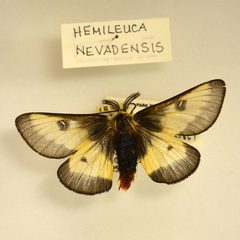
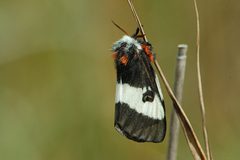
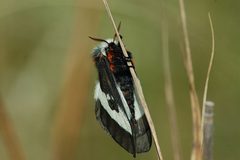
Distinguished from other Hemileuca by combination of creamy white ground color with black-edged wings and eyespots; male abdominal coloration (black with red tip) is diagnostic within the . Recent taxonomic work indicates that from the Great Plains and Great Lakes regions previously identified as H. nevadensis represent distinct species (H. latifascia and H. menyanthevora respectively), restricting true H. nevadensis to western populations.
Images
Appearance
Wings creamy white on upperside with black edges; each wing bears black eyespots. Males have black with red terminal segments; females larger overall with less contrasting abdominal coloration.
Habitat
Ridge tops, hilltops, and elevated roads with low vegetation and ample sun exposure; grassland and shrub-dominated in western North America
Distribution
Western North America from the Pacific coast east to Wisconsin and Michigan; Canadian provinces of Alberta, Manitoba, and Saskatchewan. Nominate H. nevadensis occurs in western portion of range; Great Plains and Great Lakes now assigned to other .
Seasonality
active September to December; with one annually
Diet
lack functional mouthparts and do not feed. Larvae feed on Salix (willow) and Populus (poplar).
Host Associations
- Salix - larval food plant
- Populus - larval food plant
Life Cycle
laid in rings around twigs of plant. Caterpillars spin loose cocoons in plant litter near host plant base to pupate. One per year.
Behavior
activity. Males fly well above vegetation in large circular patterns, reducing search diameter when detecting female plumes. Males exhibit no attraction to Argiope aurantia spider lures in experimental assays, unlike some .
Ecological Role
Similar Taxa
- Hemileuca latifasciaFormerly misidentified as H. nevadensis; Great Plains now recognized as distinct based on genetic divergence and geographic disjunction
- Hemileuca menyanthevoraFormerly misidentified as H. nevadensis; eastern Great Lakes bog buckmoth elevated to status based on genetic and compatibility data
- Hemileuca maiaClosely related in same phylogenetic clade; shares similar male behavioral response (no attraction to Argiope lures) and habits
Misconceptions
The taxonomic circumscription of H. nevadensis has been historically misinterpreted, with Great Plains and Great Lakes incorrectly assigned to this . These populations are now recognized as distinct species based on integrated genetic, geographic, and reproductive data.
More Details
Taxonomic Revision
A 2022 study established that true H. nevadensis is restricted to western ; Great Plains and Great Lakes populations represent cryptic now described as H. latifascia and H. menyanthevora respectively.
Predator-Prey Coevolution
Experimental studies demonstrate that male H. nevadensis do not respond to Argiope aurantia spider lures, unlike some . This pattern, shared with H. maia and H. grotei in the same clade, suggests evolved countermeasures against a tactic where spiders mimic female .
Sources and further reading
- BugGuide
- Wikipedia
- GBIF taxonomy match
- iNaturalist taxon
- NCBI Taxonomy
- Catalogue of Life
- Saturniidae | Beetles In The Bush | Page 2
- Biogeography and taxonomy of the Hemileuca maia-nevadensis Stretch species complex (Lepidoptera: Saturniidae): insights to the midcontinental populations
- Fatal Attraction: Argiope Spiders Lure Male Hemileuca Moth Prey with the Promise of Sex