
Hemileuca hera
Harris, 1841
Sagebrush Sheep Moth, Hera Buckmoth
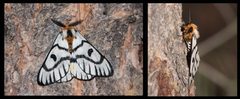
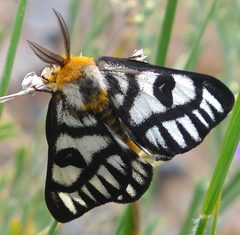
Hemileuca hera is a large, day-flying Saturniid (buck moth) native to western North America. First described by Thaddeus William Harris in 1841, this exhibits striking geographic color variation ranging from nearly white to nearly black depending on locale. are , lack functional feeding mouthparts, and do not feed. The species comprises two recognized : H. h. hera (Great Basin) and H. h. marcata (Southern Oregon). Larvae feed on sagebrush (Artemisia tridentata, A. tripartita) and other plants including Lupinus and Eriogonum.
Pronunciation
How to pronounce Hemileuca hera: //ˌhɛmɪˈluːkə ˈhɛrə//
These audio files are automatically generated. While they are not always 100% accurate, they are a good starting point.
Identification
Distinguished from other Hemileuca by geographic range (western North America from sagebrush steppe to montane ), activity, and extreme color correlated with locale. H. hera hera (Great Basin) and H. h. marcata (Southern Oregon) recognized as based on geographic separation and subtle morphological differences. Separated from H. magnifica and H. eglanterina by distribution and male response to Argiope aurantia spider lures—H. hera males show strong attraction, unlike H. maia, H. grotei, or H. nevadensis. The combination of large size, diurnal habit, and sagebrush association distinguishes it from Saturniids.
Images
Appearance
Large with wingspan 71–93 mm. display extreme geographic color : range from nearly white to nearly black, with intermediate forms showing typical orange with black markings. Day-flying with rapid, agile above vegetation . bipectinate in males, less so in females. Body robust; wings broad with reduced patterning in pale populations, bold contrasting patterns in dark populations.
Habitat
Sagebrush steppe, grasslands, and shrub-dominated in arid and semi-arid western North America. Males typically fly well above vegetation . Ridge tops, hilltops, and elevated roads with low vegetation and ample sun exposure serve as activity hotspots. Elevational range spans lowland sagebrush to montane zones.
Distribution
North America: southern Saskatchewan west to British Columbia, south through the Great Basin to Arizona and New Mexico. H. h. hera occupies the Great Basin; H. h. marcata restricted to southern Oregon.
Seasonality
on wing July to September depending on location and elevation; peak activity in late summer. Some regional variation with as early as June in southern parts of range.
Host Associations
- Artemisia tridentata - larval food plantPrimary for nominate
- Artemisia tripartita - larval food plantPrimary for nominate
- Lupinus - larval food plantRecorded for H. h. hera
- Eriogonum - larval food plantRecorded for H. h. hera
Life Cycle
Complete with , larva, pupa, and stages. Eggs laid on plants. Larvae feed on sagebrush and associated plants; larval development spans multiple instars. occurs in soil or protected locations. Adults emerge in summer, are short-lived, and do not feed due to reduced mouthparts and incomplete .
Behavior
Males engage in mate location through detection of female-emitted volatile . Searching males fly in large circular paths (500 m to 1 km diameter); upon detecting plumes, flight paths constrict and males follow concentration gradients to calling females. Males of this show strong, -variable attraction to pheromone lures of Argiope aurantia spiders, deviating from flight paths, contacting the ground or cage, and remaining near lures for extended periods—suggesting potential -prey involving chemical mimicry.
Ecological Role
Larval herbivore on sagebrush and associated legumes and buckwheats; contributes to nutrient cycling in arid shrubland . serve as prey for orb-weaving spiders, particularly Argiope that may exploit male moth attraction to . Subject to apparent coevolutionary dynamics involving chemical mimicry of mating signals.
Human Relevance
Subject of entomological research on -prey and chemical . Color variation across has drawn scientific interest in geographic . Not an agricultural pest; larvae feed on native sagebrush rather than crops. occasionally encountered by hikers and naturalists in western North American sagebrush country.
Similar Taxa
- Hemileuca magnificaOverlaps in distribution and ; both show strong male attraction to Argiope aurantia lures and belong to same phylogenetic clade. H. magnifica typically more consistently patterned.
- Hemileuca eglanterinaSimilar Saturniid habit and color , but belongs to different phylogenetic clade with variable (not consistently strong) Argiope lure response; H. eglanterina more associated with montane of California and Oregon.
- Hemileuca maiaEastern North American buck with similar but no attraction to Argiope lures; distribution distinguishes it.
More Details
Subspecies
Two recognized: Hemileuca hera hera (Harris, 1841) — Great Basin; Hemileuca hera marcata (Ferguson, 1971) — Southern Oregon. The marcata subspecies shows morphological differentiation and geographic isolation from nominate hera.
Predator-Prey Coevolution
Male H. hera show strong attraction to Argiope aurantia spider lures, suggesting these spiders may chemically mimic female . This represents a potential coevolutionary arms race between and prey, with male moths risking during mate-searching .
Historical Collection Note
Extensive geographic variation in this was documented by collector Mike Smith (d. 2003), who raised hundreds of specimens from caterpillars and across multiple ; his collection is now housed at the Bohart Museum of Entomology, UC Davis.
Sources and further reading
- BugGuide
- Wikipedia
- GBIF taxonomy match
- iNaturalist taxon
- NCBI Taxonomy
- Catalogue of Life
- Sheep Moths Draw Attention at Bohart Museum of Entomology Open House | Bug Squad
- Publications | Entomology Research Museum
- Art Shapiro: 'Butterflies as Heralds of the Apocalypse' | Bug Squad
- Butterfly Summit: Are Butterflies Heralds of Apocalypse? | Bug Squad
- Aphytis Project Final Report | Entomology Research Museum
- All Flights Lead to the Butterfly Summit | Bug Squad
- The life history of Hemileuca magnifica (Saturniidae) with notes on Hemileuca hera marcata
- Fatal Attraction: Argiope Spiders Lure Male Hemileuca Moth Prey with the Promise of Sex