
Hemileuca juno
Packard, 1872
Juno buck moth, Juno buckmoth
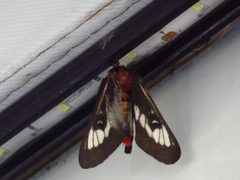
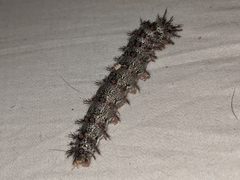
Hemileuca juno is a saturniid in the Hemileucinae, commonly known as the Juno buck moth. First described by Alpheus Spring Packard in 1872, this occurs in Central and North America. Like other members of the Hemileuca, it is a day-flying moth with larvae that possess urticating spines capable of delivering painful stings. The species is assigned Hodges number 7735.
Pronunciation
How to pronounce Hemileuca juno: /hɛˈmɪljuːkə ˈdʒuːnoʊ/
These audio files are automatically generated. While they are not always 100% accurate, they are a good starting point.
Identification
As a member of the Hemileuca, likely display the characteristic day-flying and coloration patterns typical of buck moths, which often feature bold contrasting colors such as black with white, orange, or yellow markings. The genus Hemileuca contains 24 in North America, many of which are highly variable in appearance and require careful examination for accurate identification. Larvae possess stinging spines, a trait common to the genus.
Images
Distribution
Central America and North America. Specific distribution records indicate presence in Middle America and North America.
Behavior
Day-flying, like other Hemileuca . are active during daylight hours, a trait that causes them to be frequently mistaken for butterflies.
Human Relevance
Larvae possess urticating spines that can deliver painful stings upon contact, similar to other Hemileuca . Caution is advised when encountering caterpillars.
Similar Taxa
- Hemileuca eglanterinaBoth are day-flying saturniid in the Hemileuca with similar (sheep moth vs. buck moth) and overlapping geographic ranges; may be confused due to similar size and .
- Hemileuca heraAnother highly variable Hemileuca with similar day-flying habits; both species exhibit significant geographic color variation that can complicate visual identification.
More Details
Taxonomic notes
The Hemileuca comprises 24 in North America, though this number may expand as -based studies more accurately define species boundaries and relationships.
Collection data
The Bohart Museum of Entomology at UC Davis houses approximately 50 drawers of Hemileuca specimens, reflecting the taxonomic interest in this and its considerable morphological variability.
Sources and further reading
- BugGuide
- Wikipedia
- GBIF taxonomy match
- iNaturalist taxon
- NCBI Taxonomy
- Catalogue of Life
- Sheep Moths Draw Attention at Bohart Museum of Entomology Open House | Bug Squad
- A 'Firecracker of a Surprise' in Davis: Who Knew? | Bug Squad
- A Close Call | Bug Squad
- Mary Louise Flint's Article in The Acorn: 'Butterflies in Decline' | Bug Squad
- Look but do not touch: puss caterpillar, Megalopyge opercularis; White flannel moth, Norape ovina; Io moth, Automeris io; buck moth Hemileuca spp.; and hag moth, Phobetron pithecium — Bug of the Week
- What do insects do in winter? Migrants in the DMV: Common Buckeye, Junonia coenia, Variegated Fritillary, Euptoieta Claudia, Painted Lady, Vanessa cardui, Large Milkweed bug, Oncopeltus fasciatus — Bug of the Week