
Automeris iris
Walker, 1865
Iris Eyed Silkmoth
Species Guides
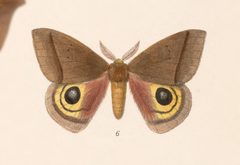
1Automeris iris is a silkmoth in the Saturniidae, known as the iris eyed silkmoth. It occurs in Central and North America. Like other Automeris , possess distinctive eyespots on the hindwings used for defense. The caterpillars bear urticating spines capable of delivering painful stings.
Pronunciation
How to pronounce Automeris iris: //ˌɔːtoʊˈmɛrɪs ˈaɪrɪs//
These audio files are automatically generated. While they are not always 100% accurate, they are a good starting point.
Identification
Distinguished from other Automeris by specific wing pattern characteristics of the eyespots, including coloration and arrangement. The two (A. i. iris and A. i. hesselorum) differ in geographic distribution and subtle morphological traits. A. i. hesselorum was described from the southwestern United States and differs from the nominate subspecies in wing markings.
Images
Habitat
Found in tropical and subtropical forested . Occurs in rainforest environments in Central America and extends into North America in suitable wooded habitats.
Distribution
Central America and North America. The nominate Automeris iris iris occurs in Central America and Mexico. The subspecies Automeris iris hesselorum is found in the southwestern United States (Arizona) and adjacent Mexico.
Behavior
are . When resting, they rely on forewing camouflage to avoid detection. If threatened, they flash the hindwing eyespots to startle . Caterpillars are active and move readily when disturbed.
Ecological Role
Caterpillars function as herbivores in forest . serve as prey for including bats and birds. The eyespot defense mechanism represents a form of antipredator that may influence predator in the .
Human Relevance
Caterpillars can deliver painful stings through urticating spines and should not be handled. The has no significant economic importance. It is valued by naturalists and photographers for its striking appearance.
Similar Taxa
- Automeris ioOverlaps in North American range and shares the eyespot defense strategy, but A. iris has more extensive blue and purple coloration in the eyespots compared to the predominantly yellow-orange eyespots of A. io.
- Automeris metzliOccurs in similar Central American rainforest and has comparable caterpillar with urticating spines, but differ in eyespot coloration and pattern.
More Details
Subspecies
Two are recognized: Automeris iris iris (Walker, 1865), the nominate form, and Automeris iris hesselorum Ferguson, 1972, described from Arizona.
Taxonomic reference
The MONA ( of North America) or Hodges number for this is 7747.