
Prodoxus quinquepunctella
(Chambers, 1875)
Five-spotted Bogus Yucca Moth
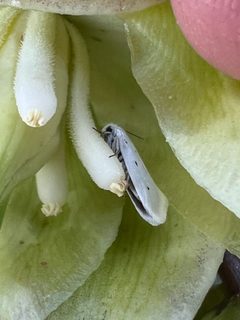
Prodoxus quinquepunctella is a small in the Prodoxidae, commonly known as the Five-spotted Bogus Yucca Moth. Unlike true yucca moths (Tegeticula), it does not pollinate yucca plants but is an obligate herbivore on yucca. Its range spans from southern Alberta, Canada, to the Mexican Plateau in northern Mexico. The has been documented in diverse including desert, grassland, and forest openings.
Pronunciation
How to pronounce Prodoxus quinquepunctella: /proʊˈdɑksəs ˌkwɪŋkwɪˌpʌŋkˈtɛlə/
These audio files are automatically generated. While they are not always 100% accurate, they are a good starting point.
Identification
Distinguished from true yucca moths (Tegeticula) by the absence of specialized tentacular mouthparts used for pollen collection. The five dark forewing spots separate it from other Prodoxus with different spotting patterns. It can be confused with other small prodoxid ; dissection or genitalia examination may be required for definitive identification. Larval presence is confirmed by exit holes in yucca fruit or stems.
Images
Appearance
Small with five distinct dark spots on the forewings, from which the derives. have a wingspan of approximately 10–15 mm. Forewings are grayish-white with dark speckling; hindwings are narrower and paler. are simple and relatively short. Larvae are -like, creamy white, and develop within yucca inflorescences or stems.
Habitat
Desert scrub, semi-arid grassland, openings in pine or deciduous forests, coastal chaparral, and sand dunes. Associated exclusively with yucca plants (Yucca spp.).
Distribution
Southern Alberta, Canada, southward through the western United States to the Mexican Plateau in northern Mexico. Records confirm presence in Alberta; distribution elsewhere is inferred from plant range and collection records.
Seasonality
have been observed from late spring through summer, with peak activity corresponding to yucca flowering periods. Exact timing varies with latitude and elevation.
Diet
Larvae feed internally on yucca tissues, including developing seeds, fruit walls, and stems. do not feed; they lack functional mouthparts for nectar or pollen consumption.
Host Associations
- Yucca - obligate herbivoreSpecific not definitively documented; likely multiple Yucca species
Life Cycle
are laid on or near yucca inflorescences. Larvae bore into yucca fruit or stems and feed internally, completing development within the tissue. occurs in a silken cocoon, often within the yucca fruit or in soil. emerge to mate; females oviposit on new yucca flowers. One per year in most of range; possibly partial second generation in southern .
Behavior
Females locate yucca inflorescences by olfactory cues. are and attracted to light. Mating occurs near plants. Unlike yucca moths, adults do not actively collect or transport pollen.
Ecological Role
herbivore on yucca. Acts as a on yucca reproductive tissues, potentially reducing seed set. Serves as prey for and other . Part of the obligate mutualism- complex involving yucca plants and their associated fauna.
Human Relevance
No direct economic importance. Occasionally encountered by yucca horticulturists when larvae damage ornamental plants. Subject of ecological research on plant-insect and mutualism exploitation.
Similar Taxa
- Tegeticula spp.True yucca moths that actively pollinate yucca; distinguished by tentacular maxillary palps for pollen manipulation and generally different wing patterns
- Prodoxus coloradensisAnother bogus yucca moth; differs in forewing spot number and arrangement, and geographic distribution
More Details
Taxonomic Note
The epithet is sometimes spelled quinquepunctellus in older literature, but quinquepunctella (feminine to match Prodoxus, treated as feminine) is the accepted form.
Research Significance
This exemplifies the evolutionary transition from mutualism to in the yucca moth lineage, making it important for studies of coevolutionary dynamics.