
Coptodisca lucifluella
(Clemens, 1860)
walnut shield bearer
Coptodisca lucifluella is a small leaf-mining in the Heliozelidae, native to eastern North America and in Europe since 2010. Larvae create distinctive blotch-shaped mines on walnut and hickory foliage, then construct oval silk-attached cases for . The has undergone a documented shift in Europe, expanding from its native specialization on Carya (pecan) to primarily exploiting Juglans regia (common walnut) and occasionally other Juglandaceae. It completes 3–4 annually in Italy, with autumn generations producing substantially more mines than spring generations.
Pronunciation
How to pronounce Coptodisca lucifluella: //ˌkɒptoʊˈdɪskə ˌluːsɪˈfluːɛlə//
These audio files are automatically generated. While they are not always 100% accurate, they are a good starting point.
Identification
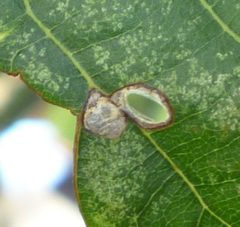
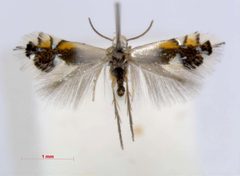
Mines appear as irregular blotch-shaped patches between leaf , never crossing lateral veins, containing visible blackish ; mean mine dimensions 7.81 × 3.48 mm. Mature larvae cut oval epidermal discs (mean 2.92 × 1.74 mm) joined by silk filaments to form portable pupal cases attached to bark, leaves, twigs, or lichens. Pupal protrude from abandoned cases after . Adults distinguished from Coptodisca juglandiella by forewing pattern and genitalia; C. lucifluella shows different mine and case construction compared to C. juglandiella.
Images
Habitat
Native range: temperate deciduous forests with Juglandaceae . range: urban and rural environments including cities, roadsides, orchards, and vineyards at 60–200 m elevation; requires presence of walnut, hickory, or wingnut trees. distribution homogeneous within infested trees.
Distribution
Native: eastern North America (USA: Texas, Mississippi, Georgia, North Carolina, Maryland, Kentucky, Pennsylvania, Ohio, Wisconsin, New York, Connecticut; Mexico). : Europe—Italy (2010, first record), Hungary (2017), Ukraine (2019), Bulgaria (2020), Romania (2022, established in 24 localities across 8 counties plus Bucharest).
Seasonality
emerge April–May in Italy; active mines present continuously June–October in Hungary. At least 3–4 per year in Italy, with autumn generations producing more mines than spring generations. Last generation larvae begin hibernation September–October. Overwinters as larva in cocoon ( following spring) or as in warmer climates.
Diet
Larval feeding: mesophyll tissue between leaf , creating blotch mines. Native range: specialized on Carya illinoinensis (pecan), with records on C. glabra and C. cordiformis. range: primarily Juglans regia (common walnut), with secondary records on J. nigra (black walnut), Pterocarya fraxinifolia (Caucasian wingnut), and Carya spp.
Host Associations
- Carya illinoinensis - primary (native range)pecan, main native
- Juglans regia - primary ( range)common walnut, in Europe
- Juglans nigra - secondary black walnut, rare instances
- Carya cordiformis - secondary bitternut hickory, range record
- Carya glabra - secondary pignut hickory
- Pterocarya fraxinifolia - secondary Caucasian wingnut, range record
Life Cycle
inserted singly into leaf tissue using ovipositor. Larval development 8–18 days; instars mine leaves creating blotch mines with blackish . Mature larva constructs oval case by cutting epidermal discs joined with silk, exits mine to attach case to substrate. Pupal stage 5–8 days. Multivoltine: 3–4 annually in Italy. stage variable: larva in cocoon with spring , or egg in warmer regions. Field larval mortality up to 74% observed in Italy.
Behavior
Female uses 14-segmented and pointed with 5-toothed oviscapt tip to pierce leaf underside and deposit single per orifice. Larva creates characteristic shield-like pupal case using silk to attach cut leaf to external substrates (bark, lichens, foliage, twigs). Mine architecture constrained by leaf venation, never crossing lateral .
Ecological Role
Leaf-mining herbivore reducing photosynthetic leaf surface area; abandoned mines leave characteristic circular holes. Potential pest of walnut orchards, though single- not considered economically serious in Italy. rates 17–32% recorded in Romania, with unidentified hymenopteran reared from mines. explosions under favorable conditions may contribute to premature tree decline when combined with other stressors.
Human Relevance
Agricultural pest of walnut in invaded regions. Not considered economically damaging alone, but may compound other tree stressors. Spread likely facilitated by international plant material trade. Monitoring and identification resources developed for European agricultural extension.
Similar Taxa
- Coptodisca juglandiellaAlso a Nearctic leafminer in Europe; distinguished by mine , case construction, and genitalia; C. juglandiella has not shown shift and remains on Juglans hosts
- Other Heliozelidae leafminersShared characteristics of disc-cutting case-making ; C. lucifluella distinguished by association, mine shape, and forewing pattern
More Details
Invasion History
First detected in Europe in Italy in 2010, subsequently spreading to Hungary (2017), Ukraine (2019), Bulgaria (2020), and Romania (2022). Rapid establishment across diverse European walnut-growing regions suggests high potential.
Host Shift Evidence
Molecular and morphological studies confirm European represent C. lucifluella, with phylogenetic analysis supporting within- shift from native Carya to -range Juglans. This shift occurred within 10 years of European introduction.
Sources and further reading
- BugGuide
- Wikipedia
- GBIF taxonomy match
- iNaturalist taxon
- NCBI Taxonomy
- Catalogue of Life
- Nearctic walnut leafminers invade Europe: first Coptodisca lucifluella (Clemens, 1860) and now Coptodisca juglandiella (Chambers, 1874) (Lepidoptera, Heliozelidae)
- "THE WALNUT SHIELD BEARER COPTODISCA LUCIFLUELLA (CLEMENS, 1860) (LEPIDOPTERA: HELIOZELIDAE) – THE FIRST RECORD IN ROMANIA THE WALNUT SHIELD BEARER COPTODISCA LUCIFLUELLA (CLEMENS, 1860) (LEPIDOPTERA: HELIOZELIDAE) – THE FIRST RECORD IN ROMANIA THE WALNUT SHIELD BEARER COPTODISCA LUCIFLUELLA (CLEMENS, 1860) (LEPIDOPTERA: HELIOZELIDAE) – THE FIRST RECORD IN ROMANIA THE WALNUT SHIELD BEARER COPTODISCA LUCIFLUELLA (CLEMENS, 1860) (LEPIDOPTERA: HELIOZELIDAE) – THE FIRST RECORD IN ROMANIA"
- Further data on the establishment of Coptodisca lucifluella (Clemens, 1860) (Lepidoptera: Heliozelidae) in Romania
- Characterization, distribution, biology and impact on Italian walnut orchards of the invasive North-American leafminerCoptodisca lucifluella(Lepidoptera: Heliozelidae)