
Aspilanta hydrangaeella
(Chambers, 1874)
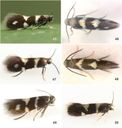
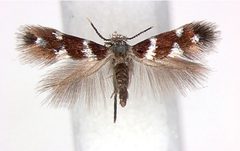
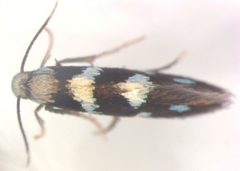
Aspilanta hydrangaeella is a minute leaf-mining in the Heliozelidae, recently transferred from Antispila to the new Aspilanta based on phylogenetic evidence. have a wingspan of 5.0–5.8 mm and are distinguished from by white-tipped . The larvae are specialized leaf miners of hydrangea plants, cutting out a shield-shaped pupal case from the leaf before . The occurs in the eastern United States.
Pronunciation
How to pronounce Aspilanta hydrangaeella: /æˈspɪlæntə haɪˌdreɪndʒiˈɛlə/
These audio files are automatically generated. While they are not always 100% accurate, they are a good starting point.
Identification
distinguished from other Aspilanta by with white tips; lack this feature. The combination of extremely small size (wingspan under 6 mm), metallic-silvery forewing pattern, and association with Hydrangea plants supports identification. Larval leaf mines begin as long, sometimes contorted linear tracks that widen into elongate blotches; changes from a narrow line to a central smear as the mine expands. The elliptic exit hole with cut-out shield case is diagnostic for Heliozelidae.
Images
Habitat
Associated with deciduous forest and woodland edges where hydrangeas grow. Found in supporting smooth hydrangea (Hydrangea arborescens) and, less frequently, snowy hydrangea (Hydrangea radiata).
Distribution
Eastern United States: Georgia, Illinois, Kentucky, Maryland, North Carolina, Ohio, and Tennessee.
Diet
Larvae feed as leaf miners on Hydrangeaceae: primarily smooth hydrangea (Hydrangea arborescens), occasionally snowy hydrangea (Hydrangea radiata).
Host Associations
- Hydrangea arborescens - primary larval smooth hydrangea
- Hydrangea radiata - secondary larval snowy hydrangea; less frequent
Life Cycle
deposited on leaves. Larvae mine leaves, creating linear-to-blotch mines with characteristic pattern. Mature larvae cut 3.5–4.5 mm elliptic cases from leaves, drop to ground, and pupate within. Pupal cases may overwinter; rearing records indicate from November to February/March/April at 1–3°C.
Behavior
Larvae are solitary leaf miners. Mature larvae actively cut shield-shaped pupal cases from leaves and exit to ground level for .
Ecological Role
Leaf herbivore specializing on Hydrangeaceae. to including Chalcidoidea and Braconidae (Microgastrinae: Dolichogenidea or Pholetesor).
Human Relevance
Minor economic significance as a herbivore of ornamental hydrangeas. Not known to cause serious damage to cultivated plants. Scientific interest due to taxonomic reclassification and phylogenetic significance.
Similar Taxa
- Aspilanta oinophyllaSimilar size and wing pattern, but feeds on Vitaceae (grape ) rather than Hydrangeaceae; lacks white-tipped .
- Other Aspilanta speciesAll share reduced wing venation and metallic markings, but differ in plant associations and coloration; A. hydrangaeella is the only in the associated with Hydrangeaceae.
- Antispila speciesFormerly classified in this ; Antispila retained in that genus have different wing venation patterns and are not associated with Hydrangeaceae.
More Details
Taxonomic history
Originally described as Antispila hydrangaeella by Chambers in 1874. Transferred to the new Aspilanta by van Nieukerken & Eiseman in 2020 based on phylogenetic analysis showing this group forms a distinct clade with reduced wing venation, sister to Coptodisca.
Leaf mine characteristics
The mine begins as a narrow, sometimes winding linear track that eventually expands into a broad blotch or gallery. deposition changes from a thin line in the early linear portion to a diffuse central smear in the expanded blotch portion, a pattern useful for field identification of active mines.