
Megaxyela
Ashmead, 1898
Species Guides
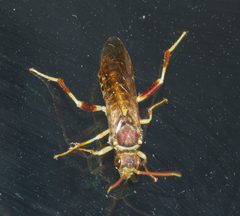
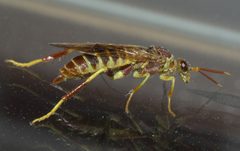
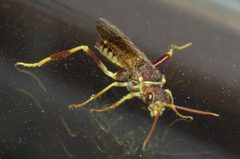
3Megaxyela is a of primitive in the Xyelidae, comprising 13 described extant . The genus has a disjunct distribution spanning the eastern Nearctic and southeastern East Asia, with fossil species known from Colorado and Shandong, China. Members are external feeders on trees in the walnut family (Juglandaceae).
Pronunciation
How to pronounce Megaxyela: /mɛɡəˈzaɪələ/
These audio files are automatically generated. While they are not always 100% accurate, they are a good starting point.
Identification
Larvae can be distinguished by their solitary habit and distinctive resting posture curled around the central leaf at leaflet apices, which resembles bird droppings. are large-bodied within the archaic Xyelidae. -level identification requires examination of morphological characters or using COI sequences.
Images
Habitat
Associated with Juglandaceae trees; larvae feed externally on leaves.
Distribution
Eastern Nearctic (eastern USA including West Virginia) and southeastern East Asia (China: Zhejiang, Hunan, Jiangsu, Hubei, Jilin, Liaoning, Shaanxi, Tibet; South Korea: Kangwon-do; Russia: Primorskiy Kray; Japan: Hokkaido, Honshu, Shikoku). Fossil from Colorado, USA and Shandong, China.
Diet
Larvae are external leaf-feeders on Juglandaceae; specific associations include Juglans ailanthifolia for M. togashii.
Host Associations
- Juglans ailanthifolia - larval for M. togashii
Life Cycle
; larval feeding period extremely brief (nine days observed in one rearing experiment of M. togashii). overwinters in an earthen constructed solely from soil, lacking parchment-like lining or fiber content.
Behavior
Larvae are solitary. Resting larvae adopt a curled posture around the central leaf at leaflet apices, which provides apparent visual mimicry of bird excrement.
Similar Taxa
- XyelaBoth are in Xyelidae; Megaxyela distinguished by larger body size and different associations with Juglandaceae versus Xyela on conifers.
- MacroxyelaBoth are Xyelidae with large body size; Megaxyela distinguished by geographic distribution and plant (Juglandaceae).
More Details
Fossil Record
Two fossil of Megaxyela have been described, from Colorado, USA and Shandong, China.
Genetic Variability
M. togashii exhibits large intraspecific genetic variability in COI sequences even among individuals from the same .
Taxonomic History
M. langstoni Ross, 1936 was removed from synonymy in a 2017 revision; lectotype designated for M. gigantea Mocsáry, 1909.
Sources and further reading
- BugGuide
- Wikipedia
- GBIF taxonomy match
- iNaturalist taxon
- NCBI Taxonomy
- Big and beautiful: the Megaxyela species (Hymenoptera, Xyelidae) of East Asia and North America
- Bird droppings on chestnut leaves or sawfly larvae: DNA barcodes verify the occurrence of the archaic Megaxyela togashii (Hymenoptera, Xyelidae) in Hokkaido, Japan