
Xyela
Dalman, 1819
pine catkin sawflies, pine shoot gall sawflies
Species Guides
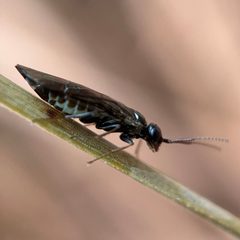
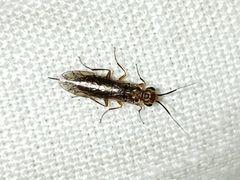
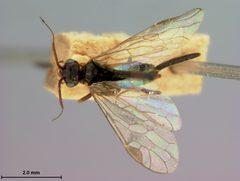
4Xyela is a of primitive in the Xyelidae, established in 1819. The genus has distribution with approximately 50 described , including both extant and fossil . Most species are associated with Pinus (pine) as larval , developing inside staminate cones; one species, X. gallicaulis, forms shoot galls instead. are early spring fliers often found on Salix or Alnus catkins near host pines.
Pronunciation
How to pronounce Xyela: //zaɪˈiːlə//
These audio files are automatically generated. While they are not always 100% accurate, they are a good starting point.
Identification
Xyela are small (typically 3-6 mm) with distinctive mandibular structure characteristic of the Xyelidae. have short, stout bodies and relatively simple wing venation. Species-level identification requires examination of genitalia and other microscopic features; an illustrated key to Eurasian species is available. Larvae are found inside pine staminate cones or, in X. gallicaulis, within shoot galls.
Images
Habitat
Pine forests and woodlands where Pinus occur. Larval is specifically the developing staminate (male) cones of pines. are found on early spring-flowering trees (Salix, Alnus) in proximity to pines. One species, X. gallicaulis, inhabits young pine shoots where it induces galls.
Distribution
distribution. Eurasian documented from Croatia, Albania, Greece, Russia, South Korea, Bulgaria, Japan, China, Mongolia, Andorra, France, Spain, Switzerland, and broader European regions. Nearctic records include Yukon Territory (Canada), Colorado, and California (USA). Distribution records also confirmed from Denmark, Norway, and Sweden.
Seasonality
fly early in spring, typically from late winter through early spring. Xyela gallicaulis adults emerge from soil from early December to mid-January; are inserted into vegetative buds during odd-numbered years, indicating a adult pattern.
Diet
Larvae feed inside staminate cones of Pinus . Eurasian species are usually monophagous on specific Pinus . Documented host associations include Pinus densiflora, P. contorta, and species in both Pinus subgenera Pinus and Strobus. Xyela gallicaulis larvae feed within shoot galls on P. taeda, P. elliottii, and P. echinata. diet not explicitly documented.
Host Associations
- Pinus spp. (Pinaceae) - larval Most develop inside staminate cones; specific associations vary by species
- Pinus densiflora - larval for multiple East Asian Xyela
- Pinus taeda - larval Primary for X. gallicaulis; most seriously damaged
- Pinus elliottii var. elliottii - larval for X. gallicaulis
- Pinus echinata - larval for X. gallicaulis
- Pinus contorta - larval Additional for X. bakeri based on distribution records and field observations
- Pinus (Strobus) parviflora - inferred larval Inferred for X. fusca based on collection data
- Salix spp. - site commonly found on catkins near plants
- Alnus spp. - site commonly found on catkins near plants
Life Cycle
Most have larvae that develop inside staminate cones of pines for 4-6 weeks. Xyela gallicaulis has a documented 2-year : larvae feed for 4-6 weeks, bore out of galls, drop to ground, and form papery cocoons in soil where they remain 22-25 months. emerge from soil ; X. gallicaulis emerges December-January and oviposits into vegetative buds during odd-numbered years. Approximately 10% of studied material across the was reared specimens.
Behavior
aggregate on early spring catkins of Salix and Alnus near pines. Larvae are monophagous with high host specificity. Host switching between Pinus subgenera (Pinus to Strobus) has been documented in closely related , with at least two cases identified. ability appears restricted based on genetic studies, yet between geographically separated populations can be high.
Ecological Role
Larvae inhabit and feed within pine staminate cones, potentially impacting pollen production and seed cone development. Xyela gallicaulis causes shoot galls that damage young pines, with documented insect associates including Rhyacionia frustrana (Tortricidae) and Conotrachelus carolinensis (Curculionidae) feeding in or on gall tissues. Deep genetic lineages in some may reflect historical refugial patterns during glacial periods.
Human Relevance
Xyela gallicaulis is a pest of young pines in forestry, particularly damaging to loblolly pine (Pinus taeda) plantations. Most other have minimal economic impact. The serves as a model for studying -plant associations, phylogeography, and historical including Beringian patterns.
Similar Taxa
- PleroneuraAlso in Xyelidae; distinguished by different associations and morphological features
- MacroxyelaRelated xyelid ; Xyela are smaller and associated with Pinus cones rather than other
More Details
Phylogeography and Host Relationships
The X. bakeri group (including X. fusca from Japan and X. bakeri from North America) represents one of two groups with trans-Beringian distributions, suggesting across Beringia with associated subgenus switching from Pinus to Strobus. East Asian species show vicariant distributions between mainland Asia and Japan dating to the Mindel-Riss interglacial period (320,000-180,000 ). Host specificity is usually monophagous, though some species pairs show host switching between Pinus subgenera.
Genetic Studies
Microsatellite markers have been developed for X. concava, revealing high between despite assumed restricted , plus deep historical segregation into two genetic lineages potentially corresponding to glacial refugia. Discordant patterns between nuclear (NaK) and mitochondrial (COI) markers suggest potential mitochondrial at the population level.
Sources and further reading
- BugGuide
- Wikipedia
- GBIF taxonomy match
- iNaturalist taxon
- NCBI Taxonomy
- Xyela fusca spec. nov. from Japan elucidates East Asian–North American relationships of Xyela (Hymenoptera, Xyelidae)
- The Eurasian species of Xyela (Hymenoptera, Xyelidae): taxonomy, host plants and distribution
- History, Distribution, Damage, and Life Cycle of a Pine Shoot Gall Sawfly, Xyela gallicaulis (Hymenoptera: Xyelidae)
- Xyela davidsmithi (Hymenoptera, Xyelidae), a New Pine Catkin Sawfly with an Unusual Host Association from the Sierra Nevada
- The East Asian Xyela species (Hymenoptera: Xyelidae) associated with Japanese Red Pine (Pinus densiflora; Pinaceae) and their distribution history
- First microsatellite markers for the pine catkin sawfly Xyela concava (Hymenoptera, Xyelidae) and their application in phylogeography and population genetics