
Vespula alascensis
(Packard, 1870)
Alaska yellowjacket, American yellowjacket
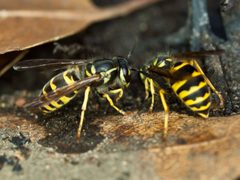
Vespula alascensis is a social native to North America, recognized as a distinct in 2010 after being treated as a taxonomic synonym of Vespula vulgaris for over a century. It belongs to the 'vulgaris group' of yellowjackets, characterized by scavenging and ground-nesting habits. The species is known to occur across northern and western regions of the continent, with confirmed records from Vermont to Hawaii.
Pronunciation
How to pronounce Vespula alascensis: /ˈvɛspjʊlə ˌæləˈsɛnsɪs/
These audio files are automatically generated. While they are not always 100% accurate, they are a good starting point.
Identification
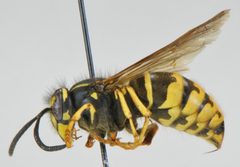
Differentiation from Vespula vulgaris and V. germanica requires close examination of morphological characters; the three form a cryptic complex with overlapping color patterns. Within its range, it may be distinguished from the Western Yellowjacket (V. pensylvanica) by geographic distribution and subtle structural differences. Males of the vulgaris group lack the strong attraction to sweets shown by .
Images
Habitat
Constructs subterranean nests in pre-existing cavities such as abandoned rodent burrows, rock walls, and similar ground-level hollows. Nests are typically located 10–15 cm below ground surface with entrance tunnels 10–30 cm long, often surrounded by a mud turret.
Distribution
North America; documented from Vermont, Hawaii, and regions across northern and western United States and Canada. Historical taxonomic confusion with V. vulgaris complicates precise range delineation.
Seasonality
Queens emerge from hibernation between March and April to initiate colonies. peak in late summer. New queens and males are produced in late summer and early fall, after which colonies decline. Reproductives mate before queens enter hibernation for the winter.
Diet
provision larvae with protein from chewed insects and carrion. consume , including honeydew from aphids and scale insects, ripe fruit juices, and human food sources. Scavenging at picnics and garbage sources is well-documented.
Life Cycle
colony cycle: solitary initiates nest in spring, raises first alone, then colony expands through summer. Mature colonies may contain several thousand workers and . New queens and males produced in fall; males die after mating, queens hibernate individually. Colonies do not persist through winter.
Behavior
Highly defensive of nest when disturbed, with aggression increasing as season progresses and food becomes scarcer. are persistent scavengers and will compete aggressively for protein and sources. Males congregate at elevated perches to await passing females during mating period.
Ecological Role
of soft-bodied insects and other arthropods; contributes to natural pest control. serve as through flower visitation. Nests provide food resources for bears, raccoons, skunks, and birds.
Human Relevance
Significant nuisance pest due to scavenging at outdoor food events, garbage containers, and agricultural settings. Defensive stinging poses medical risk to hypersensitive individuals. Venom extracts from frozen specimens are used in immunotherapy for sting allergies.
Similar Taxa
- Vespula vulgarisHistorically treated as ; now distinguished by specific morphological characters. Both belong to vulgaris group with similar and appearance.
- Vespula germanicaAnother vulgaris-group with overlapping range and scavenging ; introduced to North America and expanding westward.
- Vespula pensylvanicaWestern North American yellowjacket with similar subterranean nesting and scavenging habits; distinguished by geographic distribution and subtle morphological differences.
Misconceptions
Long treated as a synonym of Vespula vulgaris, leading to underreporting and confusion in historical records. The 2010 recognition as a distinct means many published accounts of 'V. vulgaris' in North America actually refer to V. alascensis.
More Details
Taxonomic History
Described by Packard in 1870, but relegated to synonymy under Vespula vulgaris until resurrected as a valid in 2010. This long period of taxonomic confusion means that ecological and distributional data in older literature must be interpreted with caution.
Nesting Biology
Like other ground-nesting Vespula, colonies are initiated in pre-existing cavities rather than excavated de novo. This nesting strategy reduces energy expenditure on construction and may facilitate larger colony sizes.
Sources and further reading
- BugGuide
- Wikipedia
- GBIF taxonomy match
- iNaturalist taxon
- NCBI Taxonomy
- Catalogue of Life
- The Wonderful World of Wasps | Bug Squad
- Portrait of a Yellowjacket | Bug Squad
- Beware of Yellowjacket Nests | Bug Squad
- Bug Eric: Wasp Wednesday: Western Yellowjacket
- Bug Eric: Life in a Paper Palace
- Surprise visit by a queen: German yellowjacket, Vespula germanica — Bug of the Week