
Euparagia desertorum
Bohart, 1948
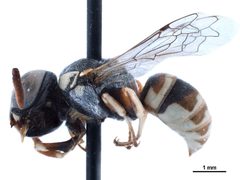
Euparagia desertorum is a of pollen wasp in the Masarinae, described by Bohart in 1948. The species epithet "desertorum" suggests an association with desert . Members of the Euparagia are among the most primitive living vespid and are to arid regions of western North America. Like other masarine wasps, are solitary and provision their nests with pollen and nectar rather than prey.
Pronunciation
How to pronounce Euparagia desertorum: /ɛuːˈpærədʒiə dɛzəˈtɔːrəm/
These audio files are automatically generated. While they are not always 100% accurate, they are a good starting point.
Identification
Euparagia can be distinguished from other masarine by their relatively simple wing venation and reduced number of maxillary palp segments. Euparagia desertorum specifically can be separated from the congeneric Euparagia unidentata by differences in mandibular and clypeal structure. are typically dark-colored with pale markings, though precise coloration for this species is not well documented in accessible literature.
Images
Habitat
Based on the epithet and -level , Euparagia desertorum is associated with desert environments. The genus Euparagia is restricted to arid and semi-arid regions of western North America, where species nest in sandy soils or use pre-existing cavities in clay banks.
Distribution
Western North America, specifically desert regions. The precise range is not well documented, but the occurs in the southwestern United States and adjacent Mexico.
Diet
feed on nectar from flowers. Females provision their nests with pollen collected from flowers, which serves as food for their larvae. Specific plants for Euparagia desertorum have not been documented.
Life Cycle
As with other Masarinae, females construct individual nests in soil or clay banks, provisioning each with a pollen mass before laying a single . Larvae develop on this pollen store without further maternal care. Developmental details specific to E. desertorum are not documented.
Behavior
Solitary nesting . Females are pollen collectors, transporting pollen on specialized scopal hairs. have been observed visiting flowers, though specific behavioral observations for this are not published.
Ecological Role
of desert flora. As a pollen , contributes to pollen transfer among flowering plants in arid . May serve as prey for larger insects and vertebrates.
Human Relevance
Minimal direct interaction with humans. Not known to be aggressive or of economic importance. Of scientific interest as a representative of a primitive vespid lineage.
Similar Taxa
- Euparagia unidentataThe only other described in the ; differs in mandibular structure and clypeal . Both species occur in western North American deserts.
- PseudomasarisAnother masarine with similar size and coloration, but Pseudomasaris have more complex wing venation and different palp segmentation.
More Details
Taxonomic placement
Euparagia has been variously placed in Vespidae or treated as the separate Masaridae. Current classifications (GBIF, NCBI) place it in Vespidae: Masarinae, though some sources recognize Masaridae as a distinct family.
Species rarity
Euparagia desertorum appears to be rarely collected, with no observations in iNaturalist and limited museum records. This may reflect genuine rarity, cryptic habits, or undercollection in remote desert .