
Euparagia
Cresson, 1879
Species Guides
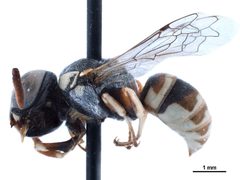
2Euparagia is the sole extant of the Euparagiinae within Vespidae. The group represents a geographically relict with a formerly distribution in past geological times, now restricted to desert regions of the southwestern United States and northwestern Mexico. The genus contains ten described , most named by Bohart between 1938 and 1988. Biological knowledge is extremely limited; only Euparagia scutellaris has been studied, with females known to provision soil nests with weevil larvae.
Pronunciation
How to pronounce Euparagia: /juːpəˈreɪdʒiə/
These audio files are automatically generated. While they are not always 100% accurate, they are a good starting point.
Identification
Members of Euparagia can be distinguished from other vespid by their placement in the Euparagiinae. The is characterized by features that separate it from the more diverse subfamilies Vespinae, Polistinae, and Masarinae. Specific diagnostic morphological characters for the genus include traits of the capsule and mesosoma that reflect its phylogenetic isolation within Vespidae. -level identification relies on examination of and original descriptions, with most species described from the southwestern United States desert regions.
Images
Habitat
Arid and semi-arid desert environments of the southwestern United States and northwestern Mexico. Nests are constructed in soil, indicating ground-nesting in sandy or friable substrates typical of desert .
Distribution
Restricted to desert regions of the southwestern United States (California, Arizona, Nevada) and northwestern Mexico (Baja California, Sonora). The represents a geographic relict with a formerly distribution during earlier geological periods.
Host Associations
- weevil larvae - preyFemales of Euparagia scutellaris provision nests with weevil larvae as food for their offspring. associations for other in the are unknown.
Life Cycle
Females construct nests in soil and provision them with prey. Development occurs within these subterranean nests. Detailed information is available only for Euparagia scutellaris; other presumably follow similar patterns but remain unstudied.
Behavior
Females exhibit solitary nesting , excavating burrows in soil and provisioning them with paralyzed or killed prey items. The shows no evidence of social colony organization. Activity patterns and mating behavior are undocumented.
Ecological Role
As a of weevil larvae, Euparagia scutellaris functions as a agent of herbivorous beetles in desert . The ecological roles of other in the are presumed similar but unverified. The genus represents a phylogenetically significant relict lineage within Vespidae.
Human Relevance
No documented direct economic importance. Potential incidental value as natural enemies of weevil pests in desert agriculture and native vegetation. Scientific interest derives from the 's status as a phylogenetic relict and its uncertain placement within Vespidae .
Similar Taxa
- MasarinaeAlso placed in Vespidae and sometimes confused with Euparagiinae in older literature, but distinguished by different nesting (cavity-nesting with nectar and pollen provisioning in Masarinae vs. soil-nesting with weevil larvae in Euparagiinae) and distinct morphological features.
- PseudomasarisDesert-dwelling vespid with similar geographic range, but members of Masarinae with different prey associations (pollen and nectar rather than weevil larvae) and nest construction in pre-existing cavities rather than soil.
More Details
Taxonomic Uncertainty
The phylogenetic placement of Euparagiinae within Vespidae has been debated. Some classifications have placed the group as a of Masaridae rather than Vespidae, reflecting uncertainty about its relationships. The subfamily is considered the sister group to all other extant Vespidae based on morphological and limited molecular evidence.
Fossil Record
The formerly distribution of Euparagiinae is inferred from fossil evidence, indicating the group was more widespread and diverse in past geological periods. The modern restricted range represents a significant contraction from its historical distribution.