
Parancistrocerus pedestris
(de Saussure, 1856)
Parancistrocerus pedestris is a small solitary mason wasp in the Vespidae, Eumeninae. The was first described by de Saussure in 1856. Like other members of its , it is a cavity-nesting that provisions its nests with paralyzed caterpillars as food for its larval offspring. The species is part of a taxonomically challenging group where live specimens are often difficult to distinguish from related species without microscopic examination.
Pronunciation
How to pronounce Parancistrocerus pedestris: //pæɹˌæn.sɪˈstroʊ.sə.rəs pəˈdɛs.trɪs//
These audio files are automatically generated. While they are not always 100% accurate, they are a good starting point.
Identification
Difficult to distinguish from such as Parancistrocerus perennis and Stenodynerus based on live images alone; microscopic examination of specimens typically required for definitive identification. The species name 'pedestris' (meaning 'of the foot' or 'pedestrian') may refer to some aspect of leg , but specific diagnostic features not documented in available sources. Separation from P. perennis requires examination of subtle morphological characters.
Images
Appearance
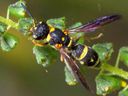
Small mason wasp with wing length of approximately 6-8 millimeters. Body slender with typical eumenine proportions. Coloration and pattern details not specifically documented for this , but often show black and yellow or black and white markings. present, with males generally having longer and blunter abdominal tips compared to females.
Habitat
Inferred from -level : occupies areas with suitable nesting cavities including hollow twigs, old borings in dead wood, and other pre-existing tunnels. Associated with open woodlands, forest edges, and areas with abundant flowering plants for nectar and caterpillars for prey.
Distribution
Eastern North America; specific range boundaries not well documented in available sources. The P. perennis ranges from southern Ontario to Florida and west to the Mississippi River, suggesting P. pedestris may have similar or overlapping distribution.
Seasonality
active during warmer months; specific period not documented. Related observed from spring through fall depending on latitude.
Life Cycle
Presumed similar to : females construct multi-celled nests in pre-existing cavities, provisioning each with paralyzed caterpillars. A single is laid on the last caterpillar in each cell. Cells are sealed with partitions made of sand glued with saliva. Larvae feed on the provided caterpillars, pupate within the nest, and emerge as the following season. Likely (one per year).
Behavior
Females hunt caterpillars, paralyzing them with venom to serve as preserved food for offspring. Nesting in cavities; nest construction involves partitioning tunnels into and sealing completed cells. Males may defend territories around nectar sources where females are expected to visit.
Ecological Role
of caterpillars, contributing to natural control of herbivorous insect . through nectar-feeding. Prey for parasitic including sapygids and cuckoo wasps that may exploit nest cavities.
Human Relevance
Potential beneficiary of blocks and artificial nesting structures provided for solitary bees and . Not known to be aggressive toward humans; sting used primarily for prey capture and defense of nest.
Similar Taxa
- Parancistrocerus perennisExtremely similar appearance; distinguished only by microscopic examination of morphological characters. P. perennis specifically documented to hunt tortricid and coleophorid caterpillars.
- Stenodynerus speciesLive specimens often indistinguishable from Parancistrocerus; historically confused and require careful morphological study for separation.
More Details
Taxonomic Uncertainty
The Parancistrocerus contains numerous that are challenging to identify from photographs. Expert hymenopterists typically require preserved specimens under magnification for accurate determination.
Nesting Biology
Like other Eumeninae, this is a cavity nester that does not construct free-standing paper nests, instead utilizing existing holes in wood or hollow plant stems.