
Parancistrocerus leionotus
(Viereck, 1906)
potter wasp, mason wasp
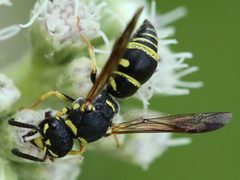
Parancistrocerus leionotus is a of potter wasp in the Eumeninae. Unlike most related species in its , it has been documented using small cavities in rocks or concrete as nest sites rather than the more typical hollow twigs or plant stems. The species was described by Viereck in 1906 and is recognized as a valid in major biological databases.
Pronunciation
How to pronounce Parancistrocerus leionotus: //ˌpær.ænˌsɪs.trəˈseɪ.rəs laɪˈə.noʊ.təs//
These audio files are automatically generated. While they are not always 100% accurate, they are a good starting point.
Identification
Distinguished from most by its documented use of rock and concrete cavities for nesting. Separation from similar Parancistrocerus requires examination of morphological characters; the contains numerous superficially similar species that are difficult to distinguish from images of live specimens.
Images
Habitat
Associated with rocky environments and human-modified structures; documented nesting in small cavities in rocks or concrete.
Distribution
Records exist from Vermont and elsewhere in the United States; specific range boundaries are incompletely documented.
Behavior
Unlike most related , uses small cavities in rocks or concrete as nest sites.
Ecological Role
As a cavity-nesting , likely serves as prey for parasitic wasps including sapygids ( Sapygidae) that target mason wasp nests.
Human Relevance
May utilize artificial structures (concrete cavities) for nesting.
Similar Taxa
- Parancistrocerus perennisSimilar size and general appearance; distinguished by range (P. perennis occurs from southern Ontario to Florida and west to the Mississippi River) and nesting substrate preferences (P. perennis uses hollow twigs, particularly sumac).
- Stenodynerus speciesExtremely difficult to distinguish from Parancistrocerus in live specimens; separation often requires microscopic examination of morphological characters.