
Eumenes mediterraneus
Kriechbaumer, 1879
Mediterranean Potter Wasp
A solitary potter wasp in the Eumeninae, recognized by its distinctive mud nest construction. Females build small urn-shaped nests attached to hard surfaces, provisioning them with paralyzed caterpillars before laying a single . The species exhibits in structure, with males possessing curled antennal tips. Two are recognized: E. m. mediterraneus and E. m. cypricus.
Pronunciation
How to pronounce Eumenes mediterraneus: //juːˈmiːniːz ˌmɛdɪtəˈreɪniəs//
These audio files are automatically generated. While they are not always 100% accurate, they are a good starting point.
Identification
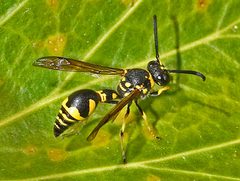
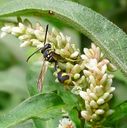
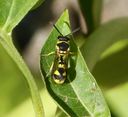
Distinguished from similar potter wasps by the specific pattern of yellow markings: mainly yellow, scutellum with two large spots, and the characteristic banding pattern on abdominal tergites I, II, V, and VI. The combination of curled male and female facial markings provides additional diagnostic features. Nest architecture—small urn-shaped mud pots with fluted necks—may aid identification where specimens are associated with their construction.
Images
Distribution
Europe, the Near East, and North Africa. Recorded from most European countries.
Behavior
Females construct free-form mud nests (urn-shaped pots approximately marble-sized with fluted necks) attached to hard surfaces such as rocks, concrete, or vegetation. Each nest is completed entirely before provisioning. The female hunts small caterpillars, paralyzes them with venom, and stocks the pot with multiple individuals. A single is laid inside the clay sphere, and the top is sealed with a final mud plug. The paralyzed prey remains fresh for larval consumption. Development proceeds through larval feeding, , and ; the adult chews an exit hole in the side of the pot. Solitary and non-aggressive; females do not defend nests actively and will abandon the site after sealing to construct additional nests elsewhere.
Ecological Role
As a of caterpillars, contributes to natural regulation of lepidopteran . Nest construction may influence local soil dynamics through mud harvesting. relationships with other organisms have been suggested but remain poorly documented.
Human Relevance
Generally considered beneficial due to caterpillar . Non-aggressive nature makes it safe to tolerate near human habitation. Mud nests may occasionally be considered unsightly when attached to structures, but pose no structural damage. Potential interest for scientific observation and - research through nest rearing.
Similar Taxa
- Eumenes coarctatusSimilar nest architecture and coloration; distinguished by distribution and specific marking patterns
- Ancistrocerus speciesAlso construct mud nests but typically build cylindrical multi-celled structures rather than single urn-shaped pots; marking patterns differ
- Sceliphron caementariumBuilds mud nests but constructs clustered multi- structures covered in mud layers rather than discrete urn-shaped pots; larger and more robust body form
Sources and further reading
- BugGuide
- Wikipedia
- GBIF taxonomy match
- iNaturalist taxon
- NCBI Taxonomy
- Catalogue of Life
- Meloidae Holdings | Entomology Research Museum
- Bug Eric: Mud Masterpieces
- Bug Eric: January 2010
- Bug Eric: Bee Flies
- Bug Eric: Wasp Wednesday: Walden's Mason Wasp, Ancistrocerus waldenii
- An Introduction to the Wonderful World of Wasps: Meet the Heath Sand Wasp - Buglife Blog - Buglife