
Sierolomorphidae
Genus Guides
1is a small of containing 13 extant across two , Sierolomorpha and Proscleroderma. The family has a fossil record extending to the Early Cretaceous, with specimens known from amber deposits. They are solitary wasps of rare occurrence, predominantly distributed in the Northern Hemisphere.
Pronunciation
How to pronounce Sierolomorphidae: //ˌsaɪroʊloʊˈmɔrfɪˌdiː//
These audio files are automatically generated. While they are not always 100% accurate, they are a good starting point.
Identification
Distinguished from other by the contiguous of the hind and midlegs, absence of claval and jugal lobes on the hindwing, and the constricted separation between the first and second metasomal sterna. The first metasomal segment may appear -like but lacks a true node. Small body size, dark coloration, and rare occurrence in Northern Hemisphere localities are supporting characteristics.
Images
Appearance
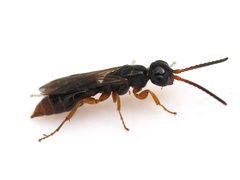
are predominantly dark brown or black in color. ranges from slight to marked; both sexes usually have wings, though females are sometimes wingless. Hind and midleg are positioned adjacent to each other. The hindwing lacks claval and jugal lobes. The first metasomal segment lacks a true node but may superficially resemble that of ants. The metasomal sternum of the first segment is separated from the second by a constriction.
Distribution
Northern Hemisphere, with extant recorded from the Palaearctic Region (5 species), North and Central America (7 species), and Hawaii (1 species). Specific countries and regions include Syria, Mongolia, eastern Russia, Uzbekistan, Canada, and the United States. Fossil specimens are known from Late Cretaceous amber of New Jersey and upper Albian amber of Spain.
Behavior
Solitary. Larvae are suspected to be ectoparasitoids of other insects, though this remains unconfirmed.
Similar Taxa
- FormicidaeFirst metasomal segment may superficially resemble petiole, but lack a true node and have distinct wing venation and leg .
- Other Vespoidea familiesDistinguished by the unique combination of contiguous mid- and hindleg , reduced hindwing lobation, and metasomal sternal constriction.
More Details
Fossil Record
The has one confirmed fossil , Loreisomorpha, from Late Cretaceous (Turonian) amber of New Jersey. A new genus Orisolemorpha was described from Early Cretaceous (upper Albian) Spanish amber, representing the earliest known occurrence of the family. Loreisomorpha has been assigned to a separate , Loreisomorphinae, based on significant differences in wing venation.
Taxonomic Uncertainty
Very little is known of sierolomorphid . The ectoparasitoid hypothesis for larvae is based on morphological inference rather than direct observation. The remains one of the most poorly understood among .