
Caliroini
Genus Guides
2- Caliroa(slug sawflies)
- Endelomyia(roseslug sawfly)
Caliroini is a tribe of in the Tenthredinidae, characterized by robust bodies and larvae that feed on ferns. The tribe includes the Caliroa, whose members are commonly known as fern sawflies. are active during spring and summer months. The group is primarily distributed across the Northern Hemisphere, with particular diversity in North America and Eurasia.


Pronunciation
How to pronounce Caliroini: //kəˈlaɪroʊ.aɪˌnaɪ//
These audio files are automatically generated. While they are not always 100% accurate, they are a good starting point.
Identification
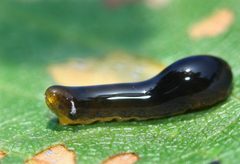
Members of Caliroini can be distinguished from other Tenthredinidae tribes by the combination of a robust, somewhat flattened body form and with 9 segments. The forewing lacks the distinctive venation patterns seen in related tribes such as Allantini. Larvae are slug-like in form, lacking the typical of many other larvae, and possess a slimy coating that distinguishes them from caterpillars of Lepidoptera.
Images
Distribution
Northern Hemisphere, with primary occurrence in North America and Eurasia.
Seasonality
activity occurs primarily during spring and summer months.
Diet
Larvae feed on ferns (Pteridophyta), with specific associations varying by .
Host Associations
- ferns - larval food plantprimary group for tribe
Life Cycle
Complete with , larval, pupal, and stages. Larvae are external feeders on fern fronds. occurs in soil or leaf litter.
Behavior
Larvae exhibit slug-like locomotion due to reduced and secrete a slimy protective coating. are and have been observed visiting flowers for nectar.
Ecological Role
Larvae act as herbivores on ferns, potentially influencing fern in localized areas. may contribute to pollination while foraging.
Human Relevance
Larvae can occasionally cause noticeable defoliation of ornamental ferns in gardens, though significant economic impact is limited. Some are of interest to entomologists studying fern-herbivore interactions.
Similar Taxa
- AllantiniBoth are tribes in Tenthredinidae; distinguished by segmentation and wing venation patterns, with Allantini having more complex forewing venation and generally more slender body forms.
- BlennocampiniAnother Tenthredinidae tribe with slug-like larvae; distinguished by larval plants (Blennocampini often associated with Rosaceae rather than ferns) and subtle differences in thoracic structure.