
Monophadnoides rubi
(Harris, 1845)
raspberry sawfly, Dark Bramble-cutter
Monophadnoides rubi, commonly known as the raspberry sawfly or Dark Bramble-cutter, is a of common in the Tenthredinidae. It is a defoliating pest of Rubus species, particularly raspberry and blackberry. The species is native to North America and has been documented across Canada and the United States.
Pronunciation
How to pronounce Monophadnoides rubi: //ˌmɒnəˈfæd.nɔɪˌdiːz ˈruː.baɪ//
These audio files are automatically generated. While they are not always 100% accurate, they are a good starting point.
Identification
Larvae can be distinguished from similar spiny caterpillars by having six or more pairs of (vs. maximum five in Lepidoptera). Within the Monophadnoides, identification to requires examination of morphological characters. The specific epithet 'rubi' refers to its association with Rubus . Similar spiny larvae in the Blennocampinae include Periclista species, which feed on oak and hickory rather than Rubus.
Images
Appearance
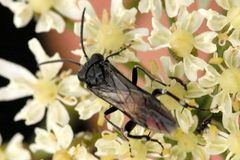
are typical with two pairs of membranous wings and a broad connection between and (lacking the narrow waist of ). Larvae possess branched spines and have six or more pairs of , distinguishing them from lepidopteran caterpillars which have at most five pairs.
Habitat
Associated with Rubus including cultivated raspberry and blackberry plantings, as well as wild bramble patches in woodland edges, hedgerows, and disturbed areas.
Distribution
North America. Documented in Canada: Alberta, British Columbia, Labrador, Manitoba. Distribution in the United States inferred from plant range and historical records, though specific state records require verification.
Diet
Larvae feed on Rubus , including raspberry (Rubus idaeus) and blackberry. Feeding occurs on foliage, with larvae consuming leaf tissue between .
Host Associations
- Rubus idaeus - larval food plantcultivated raspberry
- Rubus - larval food plantblackberry and other brambles
Life Cycle
Complete with , larval, pupal, and stages. Larvae are the primary feeding and damage-causing stage. Specific details of voltinism and stage require confirmation.
Behavior
Larvae feed gregariously when young, potentially dispersing as they mature. When disturbed, larvae may raise their spiny in a defensive posture.
Ecological Role
Herbivore and defoliator of Rubus . can cause significant damage to commercial and wild berry crops.
Human Relevance
Recognized as a pest of commercial raspberry and blackberry production. Larval defoliation reduces plant vigor and fruit yield. Management in agricultural settings may be required when exceed .
Similar Taxa
- PericlistaSimilar branched spines on larvae, but feeds on oak and hickory (Fagaceae) rather than Rubus
- Lepidoptera caterpillarsConvergent spiny appearance, but distinguished by having 5 or fewer pairs of (vs. 6+ in )
More Details
Nomenclature
The specific epithet 'rubi' directly references the Rubus, indicating the long-recognized association between this and bramble fruits. The alternative 'Dark Bramble-cutter' reflects both its association and cutting damage to foliage.