
Xeris spectrum
(Linnaeus, 1758)
wood wasp, horntail
Xeris spectrum is a large horntail or wood wasp in the Siricidae, notable within its family for lacking the fungal that other siricid use to aid larval development in wood. Females possess a powerful ovipositor used to drill into coniferous trees and deposit beneath the bark. The is widespread across Europe, Asia, Africa, and North America, where it develops in the wood of fir, spruce, pine, and larch. Development from egg to takes several years, with larvae emerging in two distinct cohorts—some in summer alongside other wood wasps, others the following spring. The species is considered a timber pest due to larval tunneling that degrades wood quality.
Pronunciation
How to pronounce Xeris spectrum: //ˈksɛrɪs ˈspɛktrəm//
These audio files are automatically generated. While they are not always 100% accurate, they are a good starting point.
Identification
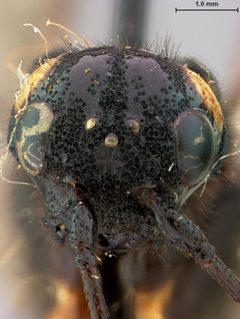
Distinguished from other Siricidae by the absence of fungal , though this is not externally visible. Externally, the combination of large size (12–28 mm), cylindrical black or dark brown shiny body with white spots behind the and on the prothorax sides, and orange-red legs separates it from many . The powerful ovipositor of females is characteristic of the but not unique to this . Males are distinguished from females by brown rings around the legs. Larvae are cylindrical and slightly flattened, up to 25 mm long, producing visible deposits of wood chips and . Pupae have extending beyond the wings at the level of the eighth segment.
Images
Habitat
Open pine forests and coniferous forests generally. Associated with coniferous trees including fir, spruce, pine, and larch. Most prevalent in homogeneous stands of fir and mixed stands of fir and spruce that have been damaged by wind, fire, snow, or pathogenic fungi. Larvae develop in the wood of damaged or stressed trees.
Distribution
Widespread across large parts of Europe, Asia, Africa, and North America. Specific distribution records include Belgium (Flemish Region, Walloon Region), Denmark, and broader regions across the Palearctic and Nearctic.
Seasonality
Males typically begin flying a few days earlier than females. emerge in two distinct periods: one cohort emerges in summer coinciding with other wood wasp , while another cohort emerges the following spring. The entire development from to adult takes several years.
Diet
Larvae feed on wood of coniferous trees, specifically fir, spruce, pine, and larch. Unlike other Siricidae, larvae do not consume fungal ; instead, they have been observed to take advantage of fungal symbionts of other wood wasp by laying in wood where such species have previously oviposited. feeding habits not documented.
Host Associations
- Abies (fir) - larval primary , especially in homogeneous stands
- Picea (spruce) - larval common , especially in mixed stands with fir
- Pinus (pine) - larval in open pine forests
- Larix (larch) - larval documented tree
Life Cycle
Complete (). Females drill ovipositors into trees just under bark to deposit . Newly hatched larvae feed on wood of damaged trees, with burrows widening and deepening as larvae grow. Larvae produce visible deposits of wood chips and . Before , larvae bore a small chamber approximately 2 cm into the tree. The pupal stage involves from soft larval body to hardened pupal shell with internal reorganization; pupal duration varies with temperature. Total development from egg to spans several years.
Behavior
Females drill into tree bark with ovipositor to deposit . Males initiate activity earlier in the season than females. exhibit two distinct phenologies: summer emergence synchronized with other wood wasp , and spring emergence the following year. Females have been observed to preferentially oviposit in wood previously colonized by other wood wasp species that possess fungal , allowing their larvae to exploit those fungi indirectly.
Ecological Role
Wood-boring insect that contributes to decomposition of damaged or stressed coniferous trees. Larval tunneling creates and entry points for other organisms. The ' unique lack of fungal among Siricidae represents an alternative ecological strategy within the , exploiting resources made available by other species rather than cultivating symbionts directly.
Human Relevance
Considered a pest in the timber industry due to larval tunneling that damages wood and decreases its commercial value. Larval densities can reach up to 60 specimens per meter of tree stem in affected stands. Damage is most severe in previously stressed or damaged forest stands.
Similar Taxa
- Other Siricidae (wood wasps)Xeris spectrum is distinguished by its lack of fungal , though this requires biological investigation rather than visual identification. Externally, the specific pattern of white spots and orange-red legs may help separate it from some .
- Urocerus spp.Other large siricid with similar overall ; specific identification requires examination of color pattern details and genitalia.
More Details
Sources and further reading
- BugGuide
- Wikipedia
- GBIF taxonomy match
- iNaturalist taxon
- NCBI Taxonomy
- Bruce Hammock: From ResearchIng Insect Science to Researching Autism and Schizophrenia | Bug Squad
- Sulfoxaflor Found to Be Less Harmful to Beneficial Predators of Soybean Aphids
- Show or Tell? Testing Peacock Spiders' Multi-Modal Mating Display
- Squash Bugs Still Making Growers Crazy After All These Years
- Anti-melanoma activity in green-produced nanosilver-chlorhexidine complex
- Infrared Photography Shows Tsetse Fly Development from Pupa to Adult