
Colpa octomaculata texensis
Saussure, 1858
Colpa octomaculata texensis is a of mammoth in the Scoliidae, first described by Saussure in 1858. It belongs to a group of large-bodied wasps whose larvae develop on scarabaeid . Recent phylogenetic research using ultraconserved element (UCE) data has clarified the evolutionary position of the Colpa, finding it to be sister to the tribe Scoliini and rendering the traditional tribe Campsomerini non-monophyletic. This subspecies represents part of a taxonomic complex that has historically been poorly resolved due to limited systematic study.
Pronunciation
How to pronounce Colpa octomaculata texensis: /ˈkɔl.pa ˌɔk.to.mæˈku.la.ta tɛkˈsɛn.sɪs/
These audio files are automatically generated. While they are not always 100% accurate, they are a good starting point.
Identification
Identification to level requires examination of spot patterns, body proportions, and geographic origin. The eight-spotted pattern distinguishes C. octomaculata from with different spot numbers or arrangements. The subspecies texensis is distinguished from the nominate subspecies by geographic distribution and subtle morphological differences. Confusion may occur with other Colpa , particularly C. sexmaculata (six-spotted) and related . Recent molecular phylogenetic studies suggest that the Colpa as currently defined may not be monophyletic, complicating identification.
Images
Appearance
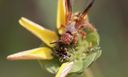
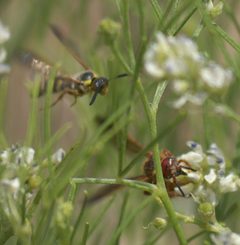
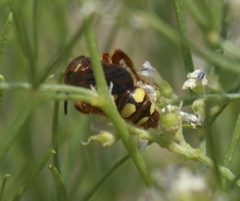
As a member of the Scoliidae, this is characterized by a large, robust body typical of mammoth wasps. The specific epithet "octomaculata" (eight-spotted) suggests the presence of eight distinct spots or maculations on the body, likely on the or wings. The subspecies designation "texensis" indicates a form associated with Texas and adjacent regions. Scoliid wasps generally possess a hairy or velvety , strong legs adapted for digging, and a relatively unconstricted waist compared to other .
Habitat
Specific associations for this are not documented. Scoliid wasps generally occur in open, sunny habitats including grasslands, savannas, and open woodlands where their scarab are abundant. are often observed visiting flowers for nectar.
Distribution
The epithet "texensis" indicates occurrence in Texas, USA, and likely adjacent regions of the southern United States and northern Mexico. The distribution of this subspecies relative to the nominate form (C. o. octomaculata) has not been precisely delineated in available literature.
Diet
feed on nectar from flowers. Larvae are of scarabaeid , developing on in the soil.
Host Associations
- Scarabaeidae - Larval ; specific scarab for this not documented
Life Cycle
As with other Scoliidae, females likely dig into soil to locate scarab beetle , sting them to induce paralysis, and deposit . Larvae feed externally on the grub, eventually pupating in the soil. Specific details for this are not documented.
Behavior
are and visit flowers. Females exhibit digging to locate . capabilities are present (unlike some flightless tiger beetles mentioned in related literature).
Ecological Role
As a of scarab beetle , this contributes to natural of scarab . may serve as when visiting flowers.
Human Relevance
Scoliid wasps are generally not aggressive toward humans and are considered beneficial due to their role in controlling scarab pests. No specific human interactions documented for this .
Similar Taxa
- Colpa octomaculata octomaculataNominate ; distinguished by geographic distribution and subtle morphological differences
- Colpa sexmaculataSix-spotted ; distinguished by number and arrangement of spots
- Scolia speciesRelated in tribe Scoliini; Colpa now recognized as sister to Scoliini based on phylogenomic data
- Campsomeriella speciesFormerly placed in same tribe (Campsomerini), now recognized as distinct lineage
More Details
Phylogenetic significance
Recent research by Khouri et al. using ultraconserved element (UCE) data has fundamentally revised understanding of scoliid relationships. The Colpa was found to be sister to the Scoliini, rendering the traditional tribe Campsomerini non-monophyletic. This has major implications for the classification of C. octomaculata texensis and related .
Sources and further reading
- BugGuide
- GBIF taxonomy match
- iNaturalist taxon
- Ziad Khouri: Zeroing in on Mammoth Wasps, the Scoliid Wasps | Bug Squad
- Sphingidae | Beetles In The Bush | Page 2
- The Moth and Me | Beetles In The Bush
- Saturniidae | Beetles In The Bush | Page 2
- Noctuidae | Beetles In The Bush | Page 3
- blog carnivals | Beetles In The Bush