
Sphaeropthalma marpesia
(Blake, 1879)
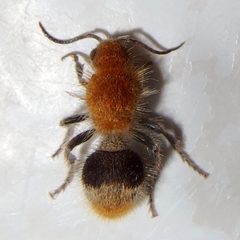
Sphaeropthalma marpesia is a of velvet ant in the Mutillidae, described by Blake in 1879. The species is distributed across the western and southwestern United States and Mexico. Velvet ants in this are solitary with wingless females and winged males. The specific epithet 'marpesia' references the Amazon Marpesia, a namesake shared with the daggerwing butterflies of genus Marpesia.
Pronunciation
How to pronounce Sphaeropthalma marpesia: /sfɛ.roʊfˈθæl.mə mærˈpi.si.ə/
These audio files are automatically generated. While they are not always 100% accurate, they are a good starting point.
Images
Distribution
Mexico; United States: Arizona, California, Colorado, Idaho, Kansas, Nevada, New Mexico, Oklahoma, Oregon, Texas, Utah, and Washington.
Behavior
Females are wingless and solitary, typical of Mutillidae. The has been observed as a of mud dauber nests (Sceliphron caementarium), where it likely preys on the larvae or provisions.
Ecological Role
or of other nests, contributing to of mud daubers and potentially other wasps.
Similar Taxa
- Sphaeropthalma arvak in the same with overlapping distribution in western North America; distinguished by specific morphological features of the and coloration patterns.
- Sphaeropthalma rataoskAnother congeneric with similar and preferences; requires examination of genitalia and thoracic structure for definitive separation.
More Details
Etymology
The specific epithet 'marpesia' is derived from Marpesia, of the Amazons in Greek mythology. This name is also applied to the daggerwing butterflies ( Marpesia), which were featured in the of the Week blog posts describing 'pumping' on tropical beaches.
Type specimen information
The was described by Blake in 1879. The UCR Entomology Research Museum holds primary for multiple Sphaeropthalma species, though the specific catalog number for S. marpesia was not provided in the available source material.
Parasitoid biology
Sphaeropthalma marpesia is documented among the natural enemies of the Black and Yellow Mud Dauber (Sceliphron caementarium), a sphecid . Velvet ants in this are known to exploit the mud nests of other wasps, where their larvae feed on the 's provisions or developing offspring.
Sources and further reading
- BugGuide
- GBIF taxonomy match
- iNaturalist taxon
- NCBI Taxonomy
- Sphaeropthalma_arvak_Williams_&_Pitts_Holotype_UCRC_ENT_67007_Dorsal.jpg | Entomology Research Museum
- Primary Type List | Entomology Research Museum
- Butterflies pumping on the beach: Daggerwings, Marpesia sp. — Bug of the Week
- Beautiful butterflies pumping water: Daggerwings, Marpesia spp., and a pierid butterfly, Cepora spp. — Bug of the Week
- Bug of the Week Academy Awards 2018 — Bug of the Week
- Bug Eric: Wasp Wednesday: Black & Yellow Mud Dauber