
Sphaeropthalma
Blake, 1871
velvet ants
Species Guides
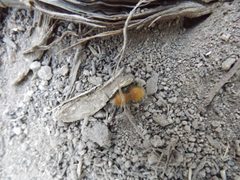
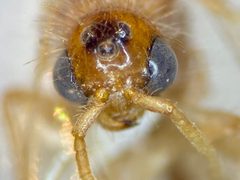
24Sphaeropthalma is a of velvet ants (Mutillidae) described by C.A. Blake in 1871. in this genus are among the smaller velvet ants and exhibit notable diversity in coloration, including red, pink, white, and black hair. The genus is distinguished by a high proportion of species, with pink-haired species being exclusively nocturnal. Sphaeropthalma species are solitary that parasitize nests of solitary wasps, particularly bembicine wasps such as sand wasps and horse guard wasps. The genus has been subject to phylogeographic research revealing cryptic .

Pronunciation
How to pronounce Sphaeropthalma: /sfɛəroʊpˈθælmə/
These audio files are automatically generated. While they are not always 100% accurate, they are a good starting point.
Identification
Sphaeropthalma are among the smaller velvet ants in the Mutillidae. Many species possess red hair, though some exhibit pink, white, or black coloration. Pink-haired species are reliably , which may aid in field identification. The lacks the extreme size variation seen in some other mutillid genera. Species-level identification typically requires examination of punctation patterns and other fine morphological details.
Images
Habitat
Dry areas and open areas. show to arid environments, with some lineages specifically arid-adapted and others Mediterranean-adapted.
Distribution
Western North America, with occurring from southern California through desert and Mediterranean climate regions. The S. arota and S. unicolor species complex have been studied for their biogeographic patterns across western Nearctic regions.
Host Associations
- Trypoxylon - S. jacala reared from cocoons
- Centris - S. jacala reared from cocoons
- Chrysis - S. jacala reared from cocoons
- Bembicinae - sand wasps and horse guard preferred for -laying
Behavior
Females scurry along the ground searching for solitary nests to parasitize. S. pensylvanica exhibits phoretic copulation, in which males physically transport females by and/or foot from their initial site of contact before mating. This was the first recorded instance in the Sphaeropthalminae. Many are , with activity recorded in some species.
Ecological Role
of solitary . Serves as for other parasitoids including cuckoo wasps (Chrysididae).
Similar Taxa
- DasymutillaBoth are of velvet ants in Mutillidae; Dasymutilla are generally larger and more conspicuously colored
- OdontophotopsisAnother mutillid with overlapping distribution; Odontophotopsis have distinctive mandibular and dental characters
Sources and further reading
- BugGuide
- Wikipedia
- GBIF taxonomy match
- iNaturalist taxon
- NCBI Taxonomy
- sphaeropthalma_rataosk_williams_pitts_holotype_female_ucrc_ent_69010_lateral.jpg | Entomology Research Museum
- Primary Type List | Entomology Research Museum
- Bug Eric: Wasp Wednesday: Black & Yellow Mud Dauber
- Bug Eric: August 2011
- Facultative Size-Dependent Sex Allocation in Sphaeropthalma pensylvanica Lepeletier (Hymenoptera: Mutillidae) with Further Host Records
- Historical biogeography of the arid‐adapted velvet antSphaeropthalma arota(Hymenoptera: Mutillidae) reveals cryptic species
- Pleistocene connection between the Nearctic Mediterranean and desert regions in the Sphaeropthalma unicolor species‐complex (Hymenoptera: Mutillidae)
- Description of the female, redescription of the male, and host associations of the Nearctic species Sphaeropthalma jacala Schuster (Hymenoptera: Mutillidae)
- Unusual Sex Allocation in a Solitary Parasitoid Wasp, <i>Sphaeropthalma Pensylvanica</i> (Hymenoptera: Mutillidae)
- Phoretic copulation in the velvet ant Sphaeropthalma pensylvanica (Lepeletier) (Hymenoptera, Mutillidae): A novel behavior for Sphaeropthalminae with a synthesis of mating strategies in Mutillidae
- Figures 1-4 from: Waldren GC, Roberts JD, Pitts JP (2020) Phoretic copulation in the velvet ant Sphaeropthalma pensylvanica (Lepeletier) (Hymenoptera, Mutillidae): A novel behavior for Sphaeropthalminae with a synthesis of mating strategies in Mutillidae. Journal of Hymenoptera Research 78: 69-89. https://doi.org/10.3897/jhr.78.55762
- Figures 5-7 from: Waldren GC, Roberts JD, Pitts JP (2020) Phoretic copulation in the velvet ant Sphaeropthalma pensylvanica (Lepeletier) (Hymenoptera, Mutillidae): A novel behavior for Sphaeropthalminae with a synthesis of mating strategies in Mutillidae. Journal of Hymenoptera Research 78: 69-89. https://doi.org/10.3897/jhr.78.55762