
Myrmilloides grandiceps
(Blake, 1872)
Myrmilloides grandiceps is a of velvet ant ( Mutillidae) in the order Hymenoptera. Originally described as Mufilla grandiceps by Blake in 1872, it was later transferred to the Myrmilloides. The species epithet 'grandiceps' refers to the notably large characteristic of this species. As with other mutillids, females are wingless and -like in appearance, while males possess wings. The genus Myrmilloides is part of the diverse velvet ant fauna of the New World.
Pronunciation
How to pronounce Myrmilloides grandiceps: //mɪrˈmɪloʊˌaɪdiːz ˈgrændɪsˌsɛps//
These audio files are automatically generated. While they are not always 100% accurate, they are a good starting point.
Identification
The combination of the Myrmilloides and the notably enlarged distinguishes this from other mutillids. Females can be recognized by their wingless condition and -like appearance with the characteristic large head. Males, being winged, require examination of genitalic structures and other subtle morphological features for definitive identification. The species is distinguished from primarily by head proportions.
Images
Appearance
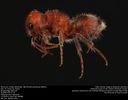
Females are wingless with a robust, -like body form typical of mutillid . The is characterized by an exceptionally large relative to body size, as indicated by the epithet 'grandiceps' (large-headed). The body is densely covered with setae (velvety pile), which is characteristic of the Mutillidae and provides protection against and desiccation. Coloration patterns are not detailed in available sources but likely include aposematic warning colors common in this family. Males possess wings and are more wasp-like in general appearance.
Distribution
The has been recorded in North America based on iNaturalist observations. Specific geographic range details are limited in available sources, but the Myrmilloides occurs in the New World.
Life Cycle
As with all Mutillidae, M. grandiceps has a lifestyle. Larvae develop as ectoparasitoids on the larvae or pupae of other insects, typically ground-nesting bees or . The female searches for nests, enters them, and deposits on or near the host immatures. Specific host records for this are not documented in available sources.
Behavior
Females are solitary foragers, searching for nests in soil or ground debris. They are capable of delivering a painful sting when handled, a characteristic defense of mutillid . The aposematic coloration serves as warning to potential . Males are more active fliers and are often encountered on flowers or patrolling for females.
Ecological Role
As a , this contributes to of ground-nesting Hymenoptera. The dense setae and aposematic coloration exemplify defensive adaptations that have ecological and evolutionary significance in -prey interactions.
Human Relevance
Like other velvet ants, females can deliver a painful sting and should be handled with caution. They are not considered economically important pests or beneficials. The has been documented by citizen scientists on iNaturalist, contributing to biodiversity records.
Similar Taxa
- Dasymutilla speciesSimilar -like wingless females with velvety setae; distinguished by -level characters of and setal patterns, and specifically by the enlarged of M. grandiceps.
- Mutilla species (Old World)Similar general appearance and ; Mutilla is primarily Old World in distribution, while Myrmilloides is New World, and the two differ in structural details of the mesosoma and metasoma.
More Details
Taxonomic History
Originally described in the Mufilla by Blake in 1872, this was later transferred to Myrmilloides. The genus Myrmilloides was established to accommodate New World species previously placed in other mutillid genera.
iNaturalist Records
As of available data, the has 143 observations documented on iNaturalist, indicating it is encountered with some regularity by naturalists and photographers, though detailed biological studies are lacking.