
Dasymutilla fasciventris
Mickel, 1938
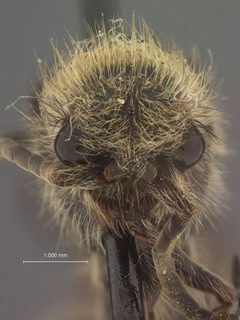
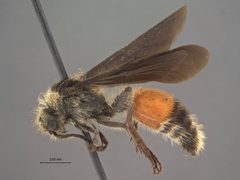
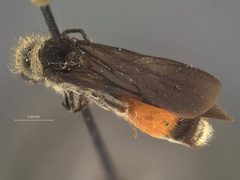
Dasymutilla fasciventris is a of velvet ant ( Mutillidae), a group of solitary in which females are wingless and males are winged. The species occurs in the southwestern United States and western Mexico. Like other Dasymutilla species, females possess a powerful sting used for defense and subjugation, while males are harmless and fly in search of nectar and mates. The species develops as an external parasitoid of ground-nesting bees and wasps.
Pronunciation
How to pronounce Dasymutilla fasciventris: //ˌdæsɪˈmjʊtɪlə ˌfæˌsɪˈvɛntrɪs//
These audio files are automatically generated. While they are not always 100% accurate, they are a good starting point.
Identification
Specific diagnostic features for D. fasciventris are not documented in available sources. As a member of Dasymutilla, it likely exhibits the characteristic velvet ant traits: females are wingless with dense, velvety , while males possess wings. -level identification in this genus typically requires examination of color pattern, hair , and microscopic features of the . D. fasciventris would be distinguished from similar southwestern species by unique combinations of these traits, though published diagnostic keys were not located.
Images
Habitat
Associated with the Madrean and Pacific coastal regions, suggesting occurrence in arid and semi-arid including desert scrub, thorn scrub, and oak woodlands. Like other Dasymutilla , likely found in sandy or loose soil environments where nests occur.
Distribution
Madrean and Pacific coastal regions of Mexico (Jalisco, Puebla, Sonora) and the United States (Arizona).
Diet
likely feed on nectar and other sugary secretions, as is known for other Dasymutilla . Larvae are that consume the stages of bees or .
Life Cycle
As with other Mutillidae, females are wingless and search for nests on the ground. Upon locating a host nest, the female enters and lays an on or near the host larva or pupa. The velvet ant larva consumes the host and pupates within the host . Males emerge from , develop wings, and fly to locate females for mating.
Behavior
Females run rapidly across the ground in search of nests. Both sexes are capable of producing audible stridulatory sounds by rubbing abdominal segments together, a defensive . Females are and active during warm periods.
Ecological Role
of ground-nesting Hymenoptera, contributing to of solitary bees and . may serve as when visiting flowers for nectar.
Human Relevance
Females can deliver a painful sting if handled; avoidance is recommended. Not known to be a significant pest or beneficial in human contexts.
Similar Taxa
- Dasymutilla occidentalisLarger eastern with similar red-and-black aposematic coloration; distinguished by geographic range and likely size difference.
- Dasymutilla gloriosaSouthwestern with extreme sexual dichromatism (females white, males typical); D. fasciventris lacks this distinctive white .
- Dasymutilla bioculataWidespread recently expanded by taxonomic lumping; distinguished by specific color pattern and distribution overlap in Arizona.
More Details
Taxonomic Note
The specific epithet 'fasciventris' refers to banded or fasciated , likely describing a color pattern characteristic of the .
Research Gap
Published biological studies and diagnostic descriptions for D. fasciventris specifically appear limited; most information is inferred from -level characteristics.
Sources and further reading
- BugGuide
- GBIF taxonomy match
- iNaturalist taxon
- Insect FAQs | Entomology Research Museum
- Bug Eric: Wasp Wednesday: Dasymutilla bioculata
- The gloriously dichromatic Dasymutilla gloriosa | Beetles In The Bush
- A sting to kill a cow? Red velvet ant, a.k.a. cow killer, Dasymutilla occidentalis — Bug of the Week
- Mutillidae | Beetles In The Bush
- Bees vs wasps: what's the difference? - Buglife Blog - Buglife