
Dasymutilla aureola
(Cresson, 1865)
Pacific velvet ant
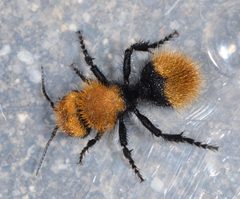
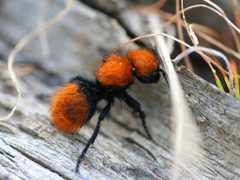
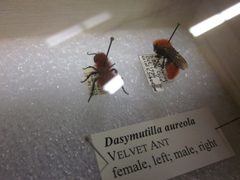
Dasymutilla aureola, commonly known as the Pacific , is a of solitary in the Mutillidae. Despite its , it is not an but a wingless female wasp. The species is found in the western United States and is characterized by its large, square-shaped and dense hair coloration in red, yellow, or orange. Like other velvet ants, females possess a potent sting used for defense and subduing .
Pronunciation
How to pronounce Dasymutilla aureola: //dæ.sɪˈmjuːtɪ.lə ɔːˈriː.ə.lə//
These audio files are automatically generated. While they are not always 100% accurate, they are a good starting point.
Identification
Dasymutilla aureola can be recognized by its large, square-shaped relative to body size. The body is covered in dense, velvety hair that appears red, yellow, or orange in color. Females are wingless, while males possess wings. The is part of the Dasymutilla , which contains many similar-looking species; precise identification may require examination of microscopic features or expert consultation.
Images
Distribution
Western United States. Specific state records are not comprehensively documented in available sources.
Human Relevance
Female Dasymutilla aureola can deliver a painful sting if mishandled, a trait common to female velvet ants. The bright coloration serves as aposematic (warning) coloration to deter . The is not considered a significant pest and does not attack humans unprovoked.
Similar Taxa
- Dasymutilla occidentalisAlso called 'cow killer,' this eastern North American shares the red and black aposematic coloration and wingless female , but occurs in a different geographic range.
- Dasymutilla gloriosaKnown as the thistledown velvet ant, this has females covered in dense white hair for (resembling plant seeds), contrasting with the brighter coloration of D. aureola.
Sources and further reading
- BugGuide
- Wikipedia
- iNaturalist taxon
- NCBI Taxonomy
- Insect FAQs | Entomology Research Museum
- Bug Eric: Wasp Wednesday: Dasymutilla bioculata
- The gloriously dichromatic Dasymutilla gloriosa | Beetles In The Bush
- A sting to kill a cow? Red velvet ant, a.k.a. cow killer, Dasymutilla occidentalis — Bug of the Week
- Mutillidae | Beetles In The Bush
- Bees vs wasps: what's the difference? - Buglife Blog - Buglife