
Timulla suspensa
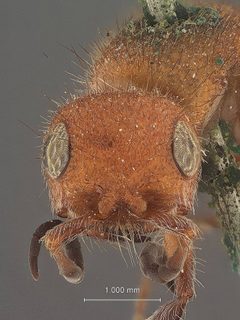
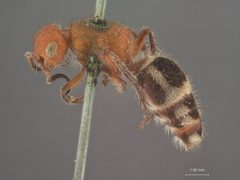
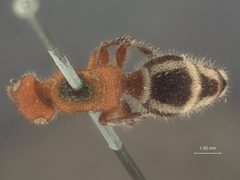
Timulla suspensa is a of wingless in the Mutillidae, commonly known as velvet ants. Females are wingless and -like in appearance, while males possess wings. The species is part of a that includes species known for their potent sting and aposematic coloration, often featuring red and black patterning that serves as warning coloration to .
Pronunciation
How to pronounce Timulla suspensa: /tɪˈmʊlə səˈspɛnsə/
These audio files are automatically generated. While they are not always 100% accurate, they are a good starting point.
Identification
Females can be distinguished from true ants (Formicidae) by the absence of a petiole node (constricted waist segment) and presence of a straight, non-elbowed . The dense velvety and robust body form separate them from most . Males are winged and more -like in appearance. Species-level identification within Timulla requires examination of microscopic characters; the is known to be taxonomically challenging.
Images
Appearance
Females are wingless with a robust, -like body form covered in dense, velvety . The body typically displays contrasting red and black coloration. Males are winged and generally more slender in build. Like all Mutillidae, the is notably thick and , contributing to their 'velvet ants.'
Habitat
Sun-dappled patches on the floor of deciduous forests, based on description for . Open, sunny areas with well-drained soils are typical for the .
Distribution
North America. Specific range boundaries for T. suspensa not documented in available sources.
Seasonality
active during warmer months. Specific for T. suspensa not documented.
Behavior
Females are solitary and ground-dwelling, searching for nests in which to lay . The Mutillidae is known for extremely painful stings used in defense; females are reportedly capable of stinging, while males cannot. Rapid, erratic running is characteristic when disturbed.
Ecological Role
of other ground-nesting Hymenoptera, particularly bees and . Females enter nests and lay on or near host larvae or pupae.
Human Relevance
The potent sting of velvet ants, including Timulla , is well-documented and can cause significant pain, though they are not considered medically dangerous to humans. They are occasionally mistaken for ants due to the wingless female . The Timulla serves as a Müllerian mimicry model for some spiders in the genus Sergiolus.
Similar Taxa
- Sergiolus capulatusSpider that exhibits striking visual mimicry of Timulla velvet ants, sharing similar red and black coloration and preferences in deciduous forest floors.
- Formicidae (true ants)Wingless females superficially resemble ants but lack the constricted petiole node and elbowed characteristic of ants.
More Details
Mimicry relationships
in the Timulla are suspected models for Müllerian or by certain ground spiders (Gnaphosidae), particularly Sergiolus species, which share similar coloration and .