
Pamphilius
Latreille, 1802
leaf-rolling sawflies
Species Guides
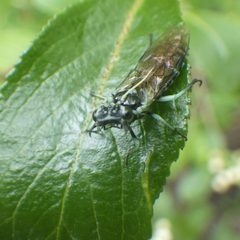
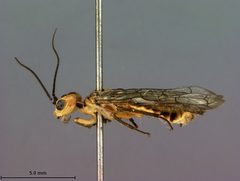
8Pamphilius is a of approximately 115 of leaf-rolling sawflies in the Pamphiliidae. are typically 10–15 mm in length with black bodies, yellowish spots on the , yellow legs, and transparent wings. Larvae are solitary or colonial leaf-rollers that feed on various deciduous trees and shrubs. The genus has a Holarctic distribution, occurring in North America and Eurasia.
Pronunciation
How to pronounce Pamphilius: //pamˈfiːliʊs//
These audio files are automatically generated. While they are not always 100% accurate, they are a good starting point.
Identification
Distinguished from other Pamphiliidae by the combination of tarsal claw structure (one and one subapical tooth), large sickle-shaped , and specific color pattern of black body with yellow markings. -level identification requires examination of morphological details and often plant association.
Images
Appearance
measure 10–15 mm in length. Body predominantly black with yellowish spots on the . Legs yellow. Wings transparent. Tarsal claws possess one and one subapical tooth. large and sickle-shaped.
Habitat
Hedge rows and forest edges. Larval microhabitat consists of rolled leaves on plants, with some found in shadowy forests on small young trees.
Distribution
Holarctic: North America and Eurasia. Specific have more restricted ranges; for example, P. ishikawai is known from central Honshu, Japan, and P. japonicus from Tochigi and Ibaraki Prefectures, Honshu, Japan.
Seasonality
activity period from May until June. Larval feeding period approximately 15–18 days in summer. as larvae in soil; lasts approximately 10 months.
Diet
Larvae feed on leaves of various deciduous trees and shrubs. plant include Rosaceae, Betulaceae, Salicaceae, Aceraceae, Caprifoliaceae, Fagaceae, Cornaceae, Juglandaceae, and Saxifragaceae. Specific host associations vary by : P. vafer feeds primarily on Alnus incana; P. ochreipes on Viburnum opulus; P. ishikawai on Astilbe species; P. japonicus on Cornus; P. phyllisae on Quercus rubra.
Host Associations
- Rosaceae - larval plant primary for many
- Betulaceae - larval plant primary , including Alnus incana for P. vafer
- Saxifragaceae - larval plant first record for Pamphiliidae, via P. ishikawai on Astilbe
- Cornaceae - larval plant first Old World record for , via P. japonicus on Cornus
- Caprifoliaceae - larval plant P. ochreipes on Viburnum opulus
- Fagaceae - larval plant P. phyllisae on Quercus rubra
Life Cycle
Holometabolous. Larvae undergo 5 or 6 instars, with 5 instars more common. Larval feeding period lasts 15–18 days, during which a single larva consumes 1–3 medium-sized leaves. occurs in soil without cocoon formation. or multivoltine reported; some exhibit 1-, 2-, or multi-year cycles with approximately 6 weeks spent on tree. occurs as larva in soil with lasting approximately 10 months.
Behavior
Larvae are leaf-rollers, either solitary or forming colonies. They construct and inhabit rolled leaves on plants, with specific morphological and physiological adaptations enabling this lifestyle. Leaf-rolling involves manipulating host plant leaves into protective shelters while feeding.
Ecological Role
Herbivores that modify plant leaves through leaf-rolling . have been documented, with one recorded instance exceeding 1 million ultimate instar larvae per acre on northern red oak. by larvae has been observed.
Human Relevance
Generally harmless to people. Most do not pose economic concern, though some may occasionally affect ornamental plants. One of P. phyllisae on northern red oak reached pest-level . Basic natural history and distribution remain incompletely documented, with recent studies revealing significant range extensions.
Similar Taxa
- Other Pamphiliidae generashare characteristics but differ in tarsal claw structure, shape, and coloration patterns
- Other Symphytadistinguished by leaf-rolling larval and specific morphological features of Pamphiliidae
More Details
Species diversity
contains approximately 115 , with ongoing taxonomic revisions. The P. vafer complex in Europe includes four species: P. vafer, P. pallipes, P. nigrifemoratus, and P. kontuniemii.
Molecular studies
COI gene sequence analysis has been used to confirm identity and examine genetic variability, revealing very small genetic variability within P. ishikawai and suggesting probable monophyly of the P. sulphureipes group.
Research gaps
plants remain unknown for many . Full details are documented for relatively few species, with most information derived from P. vafer, P. ochreipes, P. ishikawai, P. japonicus, and P. phyllisae.
Sources and further reading
- BugGuide
- Wikipedia
- GBIF taxonomy match
- iNaturalist taxon
- NCBI Taxonomy
- Catalogue of Life
- Pamphilius-ocreatus - Entomology Today
- Sawfly Species Found in Arkansas Show Range Expansions of Hundreds of Miles
- Leaf-rolling Sawflies of the Pamphilius vafer complex (Hymenoptera, Pamphiliidae) in Europe
- Pamphilius ishikawai feeds on Astilbe: the first record of Pamphiliidae (Hymenoptera) associated with Saxifragaceae
- On the morphology, biology and behaviour of the larval Pamphilius vafer (Linnaeus) (Hymenoptera: Pamphiliidae)
- Pamphilius japonicus feeds on Cornus: the first Old World record of Pamphiliidae (Hymenoptera) associated with Cornaceae
- A STUDY OF THE BIOLOGY OF THE WEB-SPINNING SAWFLY PAMPHILIUS OCHREIPES (HYMENOPTERA: PAMPHILIIDAE) IN ONTARIO
- AN OUTBREAK OF A SAWFLY, PAMPHILIUS PHYLLISAE (HYMENOPTERA: PAMPHILIIDAE), ON NORTHERN RED OAK, WITH NOTES ON LARVAL MORPHOLOGY