
Megachile pugnata
Say, 1837
Pugnacious Leafcutter Bee, Sunflower Leafcutting Bee
Species Guides
2- Megachile pugnata pomonae
- Megachile pugnata pugnata(sunflower leafcutting bee)
Megachile pugnata is a solitary, cavity-nesting leafcutter bee native to North America. Females construct nests in preexisting hollow cavities using cut leaves to line , which are partitioned by plugs of mud, sand, or vegetation. feed exclusively on flowers in the Asteraceae , making them particularly effective of sunflowers. The exhibits strong instinctive , with females preferentially nesting near conspecifics even when cavities are abundant. Males emerge before females in spring, mate quickly, and die, while females live approximately two months and produce 35-40 across multiple nests.
Pronunciation
How to pronounce Megachile pugnata: /ˌmɛɡəˈkaɪli pʌɡˈneɪtə/
These audio files are automatically generated. While they are not always 100% accurate, they are a good starting point.
Images
Appearance
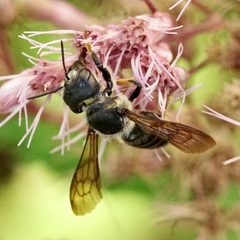
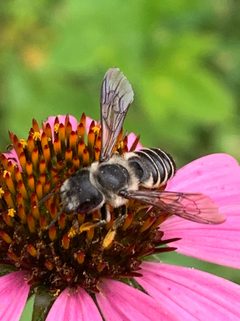
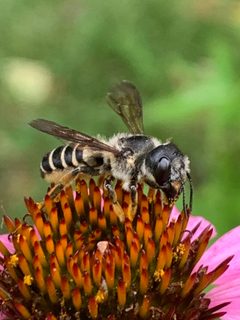
A large Megachile with females 12-18 mm and males 11-13 mm in body length. Both sexes have entirely black outer . Females possess black and densely packed scopal hairs on the for pollen collection; males have grey-green eyes and much less dense abdominal hair rings. Both sexes have large, powerful used by females to cut leaves. Females have a pointed abdominal terminus, while males have a clublike, rounded abdomen. Female limbs are uniformly hairy; male forelimbs are modified with dense brushes of bright yellow hair.
Distribution
Native to North America. In Canada, ranges from Prince Edward Island west to British Columbia, and from the southern border north to Northwest Territories and Yukon. In the United States, extends south to Georgia and west to southern California. Absent from parts of the Great Plains, Great Basin, and Gulf Coast.
Seasonality
emerge in early spring, with males emerging before females. Active during spring and summer months; females live approximately two months during nesting season.
Diet
feed exclusively on flowers in the Asteraceae , including sunflowers, asters, and daisies. Larvae feed on provisioned pollen and nectar balls.
Life Cycle
are 1-1.5 mm by 3-4 mm, oblong, changing from opaque to translucent during development; hatch in approximately 6 days. First and second instar larvae feed only on the nectar-rich area of the pollen ball where the egg was laid. Third instar larvae begin feeding on the entire pollen mass using , continuing for roughly 6.5 days through fifth instar. Fifth instar larvae feed for approximately 15 additional days, producing pellets, before spinning a silk cocoon anchored to frass and walls. Larvae overwinter as in cocoons. occurs in spring and takes roughly 22.3 days, with males pupating faster and emerging before females.
Behavior
Females are solitary nesters that preferentially aggregate nests near conspecifics at multiple spatial , even when cavities are abundant; this is proposed to provide genetic benefits through access to diverse mating partners. Females sometimes prefer to initiate nesting at edges of nesting blocks but are unresponsive to cavity position within shelters. Nests are constructed in preexisting cavities 5-10 mm in diameter, lined with cut leaves, and partitioned into 3-4 per nest using plugs of mud, sand, chewed leaves, whole leaves, or grasses. Each cell contains one pollen-nectar ball and one . Females take approximately one day to construct a single cell and make multiple foraging trips to provision each cell, mashing pollen and nectar with . Males defend territories near nest sites and die shortly after mating.
Ecological Role
Effective of sunflowers and other Asteraceae, foraging early in the day when male sunflowers release pollen. Considered for commercial agricultural use but less suitable than because are partitioned by plugs rather than individually wrapped in leaves, making separation difficult and increasing transmission risk. Parasitized by melittobia and monodontomerus and the cuckoo bee Coelioxys alternata.
Human Relevance
Evaluated as a potential commercial for sunflower agriculture. Not currently widely used due to management challenges related to structure and risk. NatureServe conservation status G5 (secure, not at risk).
Similar Taxa
- Megachile rotundataBoth are large Megachile used for agricultural pollination, but M. rotundata wraps individual in leaves (making them separable for management), while M. pugnata uses plugs between cells; M. rotundata also has a broader plant diet beyond Asteraceae.
Sources and further reading
- BugGuide
- Wikipedia
- GBIF taxonomy match
- iNaturalist taxon
- NCBI Taxonomy
- Catalogue of Life
- Looking for Cheap Urban Real Estate | Bug Squad
- In Search of the World's Biggest Bee: How It Came to 'Bee' | Bug Squad
- Photographer Allan Jones Exudes Patience, Skill and Talent | Bug Squad
- The Most Incredible Image of a Leafcutter Bee | Bug Squad
- The Native Bees in the UC Davis Bee Haven | Bug Squad
- Mailbox posts are fine homes for giant resin bees, Megachile sculpturalis — Bug of the Week
- An eagerness for conspecifics: The distribution of nests of the sunflower leafcutting bee, <i>Megachile pugnata</i> (Megachilidae), when nesting cavities are in excess