
Megachile pruina
Smith, 1853
Hoary Leafcutter Bee
Species Guides
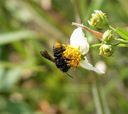
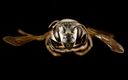
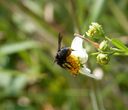
1Megachile pruina, commonly known as the Hoary Leafcutter Bee, is a solitary leafcutter bee in the Megachilidae. It is medium-sized (11–13 mm) and exhibits sexual dichromatism, with females often appearing very dark. The occurs along coastal from Virginia to Florida and westward to Texas, with an isolated in Bermuda that represents a genetically distinct evolutionary lineage. Bermuda's population is classified as Vulnerable and is the only protected under the Bermuda Protected Species Act.
Pronunciation
How to pronounce Megachile pruina: //ˌmɛɡəˈkaɪli ˈpruɪnə//
These audio files are automatically generated. While they are not always 100% accurate, they are a good starting point.
Identification
Distinguished from other Megachile by its medium size (11–13 mm), coastal distribution, and the very dark coloration of females. The Bermuda is genetically distinct from mainland US populations. Former classifications (M. pruina bermudensis, M. pruina nigropinguis) based on color variants are likely invalid based on 2024 genetic evidence showing no significant genetic differentiation among US populations.
Images
Appearance
Medium-sized measuring 11–13 mm in length. Sexual dichromatism is present: females can be very dark in coloration, while males differ in appearance. The exhibits the general Megachile body plan with a robust build typical of leafcutter bees.
Habitat
Coastal . In Bermuda, restricted to the Castle Harbour Islands Nature Reserve, primarily on Nonsuch Island (11.5 ha), with additional observations on Cooper's Island, Southampton Island, Horn Rock, and Castle Island.
Distribution
United States: Virginia to Florida, westward to Texas, mostly along coastal . Bermuda: native, currently restricted to Castle Harbour Islands Nature Reserve.
Human Relevance
Bermuda's is the only protected under the Bermuda Protected Act (Vulnerable status, 2016). Subject of conservation concern due to restriction and low genetic diversity in the isolated Bermuda population.
Similar Taxa
- Other Megachile speciesM. pruina can be distinguished by its specific size range, coastal distribution, and female coloration; genetic analysis confirms its distinct lineage, particularly for the Bermuda
More Details
Taxonomic History
Originally described by Smith in 1853. Bermuda specimens were initially classified as M. pruina bermudensis (1929), later reclassified as M. pruina pruina. A second subspecies M. pruina nigropinguis was described in 1937 for a dark female variant from Texas. 2024 genomic analysis found Bermuda genetically distinct from all US populations, and no genetic differentiation among US populations, suggesting subspecies classifications are invalid.
Conservation Genetics
2024 study found Bermuda's M. pruina has lower genetic diversity than US , indicating higher vulnerability than previously recognized. The population shows no close genetic association with any sampled US population, supporting its status as a unique evolutionary lineage.
Sources and further reading
- BugGuide
- Wikipedia
- GBIF taxonomy match
- iNaturalist taxon
- NCBI Taxonomy
- Catalogue of Life
- Looking for Cheap Urban Real Estate | Bug Squad
- In Search of the World's Biggest Bee: How It Came to 'Bee' | Bug Squad
- Photographer Allan Jones Exudes Patience, Skill and Talent | Bug Squad
- The Most Incredible Image of a Leafcutter Bee | Bug Squad
- The Native Bees in the UC Davis Bee Haven | Bug Squad
- Mailbox posts are fine homes for giant resin bees, Megachile sculpturalis — Bug of the Week
- Evolutionary genomics analysis reveals a unique lineage of Megachile pruina found in an isolated population in Bermuda